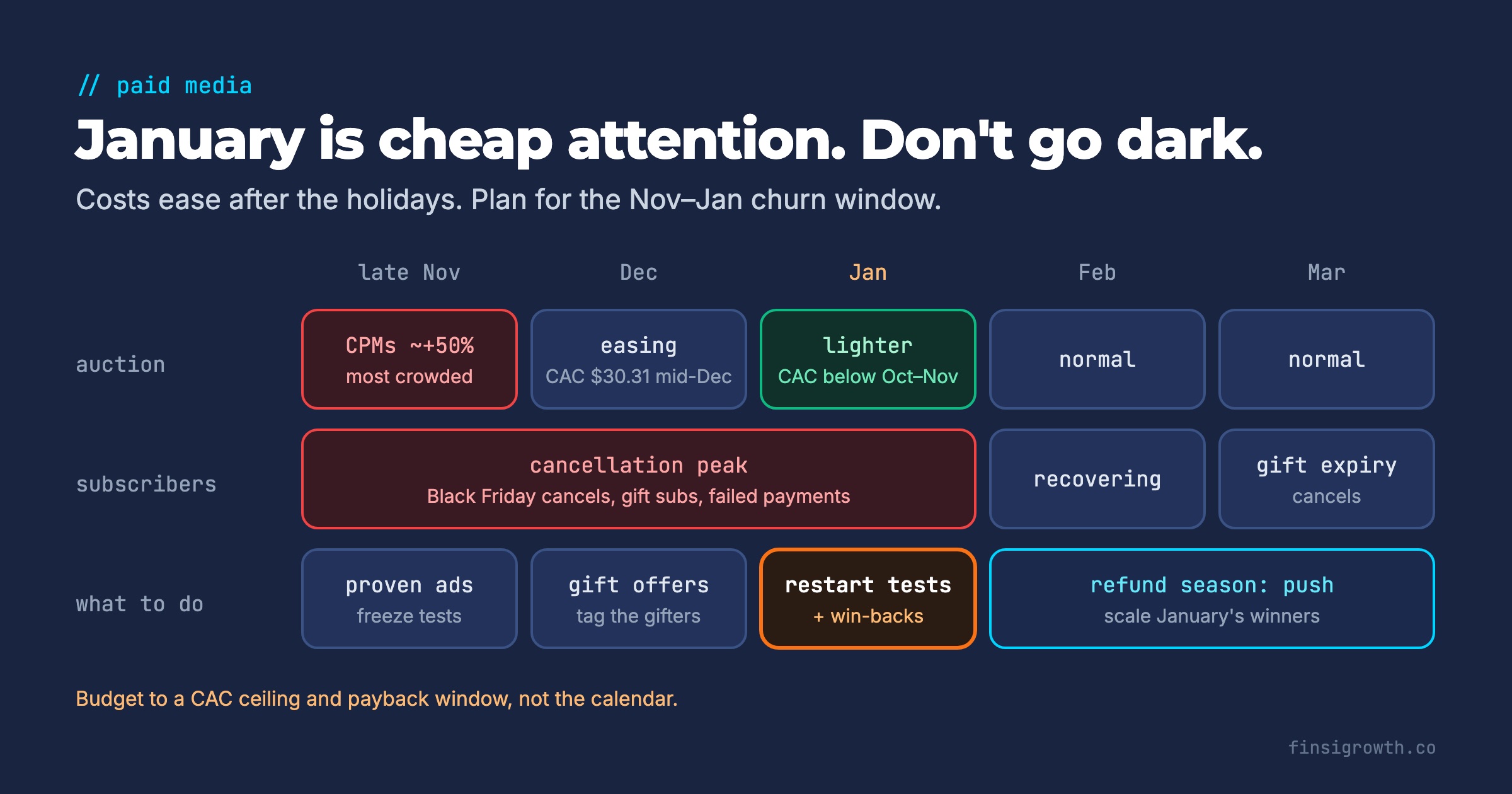
Cutting ad spend in January is one of the most expensive habits in DTC. The auction clears out after Black Friday, so each dollar buys more attention. Then refund season puts cash back in your customers’ pockets. Brands that go dark in January give up their cheapest acquisition window of the first half.
What January does have is a churn problem, and that’s a separate issue. Subscription cancellations cluster from November through January, so the base shrinks just as the budget gets cut. The fix isn’t to stop buying customers. Plan acquisition and retention as one Q1 budget, and put a payback number on each.
Key Takeaways
- Q4 auctions are the expensive ones. One book subscription box we work with saw CPMs rise about 50% in late November while competitors ran 40–70% off.
- Costs ease after the holidays. A vinyl subscription club’s blended CAC fell to $30.31 in mid-December, down from October and November.
- Subscription cancellations peak from November to January. Plan saves, dunning and win-backs for that window instead of reacting in February.
- Refund season comes next. By March 21, 2025, the IRS had issued 55.7 million refunds averaging $3,221.
- Set Q1 budgets with a CAC ceiling and a payback window, not a calendar. Spend up to the ceiling and stop where the numbers say stop.
Why does January feel dead?
January feels dead because people compare it with December. Revenue falls from a peak where promotions, gifting and pent-up demand stacked on top of each other. Measured against that, any normal month looks like a collapse.
The reasons founders give for cutting usually fall into three buckets:
- “Sales are slow after the holidays.” True against December, but that describes the comparison, not the unit economics of a January customer.
- “People are broke.” Some are. Across the brands we work with, the most common cancellation reason is still some version of “love it, but cutting back.” That’s a retention signal, not a reason to stop prospecting.
- “Let’s wait until the numbers recover.” The numbers often recover because someone kept buying. If you go dark, your February baseline starts lower.
Here’s the question that matters: what does a customer cost in January, and how long until they pay you back? Weak demand and expensive demand are different problems. January often has slightly weaker demand at a much lower price.
What happens to ad auctions after BFCM?
Ad auctions get crowded in Q4 because nearly every retailer bids for the same people at once. Prices rise for everyone, including brands that aren’t running a sale. Once the promotions end, the extra bidders leave and costs ease.
Our call data shows the shape clearly:
- A book subscription box, late November 2025. CPMs rose about 50%. CAC jumped even faster as competitors promoted 40–50% off, and some apparel brands went to 65–70% off. Creative testing cost roughly twice its normal price.
- The same box, mid-November. Meta metrics fell across the board except CPC. Google search was unaffected and stayed strongly profitable, because it spends against demand that already exists.
- The same box, early December. After BFCM, click-through rate came back up and CPC improved.
- A vinyl subscription club, mid-December. Blended CAC came in at $30.31, down from October and November.
- A fragrance subscription operator. From their history, CAC and churn were both worst from November to early January. January and February recovered, and March was the best month of the year.
That’s why we tell clients to freeze creative testing during BFCM and restart it in mid-January. A test that would cost $1,000 in February can cost $2,000 in late November, for the same answer.
January is when you get your testing budget back. It isn’t the month to cut it.
Should you pull back or keep spending in January?
Keep spending wherever your January CAC sits below your ceiling, and cut only where it doesn’t. That’s a rule you can run every week. The calendar can’t tell you that.
The better-run brands we talk to work exactly this way:
- A subscription-first supplement brand sets one blended CAC threshold for the year. It acquires “as many customers as we can up to that spend threshold.” It pulls back only in genuinely bad environments, and when marketing asks to go slightly over, the usual answer is yes.
- A $20M apparel brand runs Q1 through Q3 on pure profitability: every new customer order should be profitable, and budgets move weekly. Q4 gets a set budget up front, then gets optimized.
- A frozen-food brand had record orders over BFCM, then froze its account because the numbers looked “crazy.” CTR and CPC were within normal variance. Our advice was to resume spend, not wait.
None of these brands use “it’s January” as an input. They use CAC, contribution and payback.
Cutting has a hidden cost too. A lender that finances DTC ad spend gave us a useful way to frame it: monthly churn × CAC is your maintenance spend. It’s what you pay just to keep the base the same size. In January, churn is high, so maintenance spend is high. Cutting acquisition then doesn’t save money. It shrinks the business.
| Q1 decision | What it looks like | When it’s right |
|---|---|---|
| Hold or raise spend | Keep campaigns running, restart testing mid-January | January CAC is at or below your ceiling |
| Shift channel mix | Move budget toward search where demand already exists | Meta CAC is still high but search is efficient |
| Pull back | Cut spend on specific campaigns, not the account | CAC is above ceiling for two to three weeks on real volume |
| Go dark | Turn everything off | Almost never. You lose learning, and your February baseline starts lower |
What does Nov–Jan subscription churn look like?
Subscription churn bunches up in a predictable window from Black Friday to mid-January. If you run a subscription, plan for it the way you plan for BFCM inventory.
Here’s what it looks like across the brands we work with:
- A personalized supplement subscription says November to January are its worst cancellation months. The quote: “I need to update my budget and cancel the subscription.”
- The book subscription box saw a cancellation spike in Black Friday week. People spend, see the total and cancel. Gift subscriptions never renew either, and they’re about 10% of the base, a share that grows after the holidays.
- A dog subscription box sees “a dip in January” every year. Some customers only wanted one month, or only wanted the offer.
- A vinyl subscription club found that a big holiday spending push brought in a lot of low-quality customers who canceled soon after. Its new rule: spend more only when ROAS is good and CPA is low.
There’s also a later wave. The book box expects a spike in March, when gift cards and gifted plans run out. Our advice to a dog box client back in October still holds: “Nothing good happens in subscription world before January. People cancel.” So we told them to double down in February and March, not hide in Q1.
The cancellation wave isn’t a reason to stop acquiring. It’s a reason to stand up three things before it hits.
1. Save offers that match the reason
“Cutting back on spending” is a real reason, so offer a cheaper path, not a bigger discount. The book box added a downgrade option to its cancel flow. Its 3-month plan was the #2 cancelled product by count and #1 by lost MRR. A downgrade keeps a customer at lower revenue instead of zero.
2. Dunning that’s aggressive enough for January
Failed payments rise when cards are maxed out after the holidays. For insufficient-funds and general declines, we recommend retrying up to about 10 times, every other day. For other decline types, 7–8 attempts is enough. A weak dunning setup turns a temporary cash crunch into permanent churn.
3. Win-backs that start in mid-January
Don’t try to win back a budget canceller on December 28. Their budget hasn’t reset yet. We tell clients to reconnect in mid-January, and to segment by reason first. A win-back campaign for a gifter who never meant to subscribe differs from one for a loyal customer who paused to save money.
Why do refunds make February and March worth planning for?
Tax refunds put a large, predictable amount of cash into US households in February and March. Buying is easier when customers have extra cash, so refund season is the time to push.
The scale is large. By March 21, 2025, the IRS had issued more than 55.7 million refunds, totaling nearly $179.5 billion. The average was $3,221, up 4.6% on the year before (CPA Practice Advisor, reporting IRS filing-season data, March 2025).
The brands we work with see this in their own numbers. The book box names February tax refunds as a buying moment. The fragrance subscription operator called March the best month of the year. Our standing advice to subscription clients is that February and March are when you press, not when you start.
Here’s the catch: you can’t press in February from a standing start. If you went dark in January, your campaigns are back in Meta’s learning phase. Your creative pipeline is empty, and your email list hasn’t heard from you. So January spend isn’t only about January customers. It’s what lets February work.
How should you set a Q1 budget?
Set your Q1 budget from the CAC you can afford, the payback window you can fund, and the churn you expect. Here’s the calculation in four lines:
- Find your CAC ceiling. Take first-order contribution margin plus the margin from repeat orders inside your payback period. For example, with $35 on the first order and $25 more within 90 days, a 90-day payback allows up to $60.
- Estimate January churn. Use last year’s November-to-January cancellations, not your annual average.
- Compute maintenance spend. Expected cancellations × CAC. That’s the budget needed just to stand still.
- Add growth spend on top, and move it weekly based on CAC against the ceiling.
One client of ours, the book box, knows its numbers well enough to do this. It puts LTV at about $200, and up to $50 CAC is acceptable for its high-value cohort. With that, January is a budget question, not a mood. Client results are specific outcomes, not typical or guaranteed.
| Month | What the auction does | What subscribers do | What to do |
|---|---|---|---|
| Late November | Most crowded; CPMs up ~50% in our data | Black Friday week cancels | Freeze creative tests; run proven ads |
| December | Easing after BFCM | Gift subs bought, won’t renew | Annual and gift offers; tag gifters |
| January | Lighter; CAC lower than Oct–Nov | Budget cancels and failed payments | Restart testing mid-month; win-backs from mid-January |
| February | Normal | Recovering | Scale winners into refund season |
| March | Normal | Gift-card and gift-plan expiry cancels | Push; save offers for gift expiries |
What to do this week
- Pull last year’s November-to-February CAC by week. Use blended CAC from ad spend and new customers in Shopify, not platform-reported CPA. Check whether January was actually expensive or just low-volume.
- Write down your CAC ceiling from contribution margin and a payback window. Share it with whoever runs your ads, and make it the rule for Q1.
- Restart creative testing on a fixed date in mid-January. Put one new concept a week into a separate testing budget, not your evergreen campaign.
- Check your dunning settings. If insufficient-funds declines get fewer than about 10 retries, change it today.
- Build three cancellation segments: budget cancels, gift subscriptions that won’t renew, and promo-only customers. Schedule budget-cancel win-backs from mid-January.
- Calculate maintenance spend: last January’s cancellations × your CAC. Compare it with your planned January budget. If the budget is smaller, you’ve planned to shrink.
- Put February and March pushes on the calendar now, so creative and offers are ready before refunds land.
Frequently Asked Questions
Is January a bad month for DTC sales?
It’s lower than December, which isn’t the same as bad. Across brands we work with, acquisition costs ease after Black Friday, and CAC comes down from October–November levels. Judge January by CAC and payback, not by its gap to December.
Should subscription brands stop acquiring during cancellation season?
No. Cancellations from November to January raise the spend needed just to keep the base flat. Stopping acquisition then shrinks the business. Fix churn with save offers, dunning and mid-January win-backs while you keep acquiring.
When should I restart creative testing after BFCM?
Mid-January. Testing during BFCM costs roughly double in our client data, because the auction is crowded with discounted offers. In January, the same test budget buys more impressions and a cleaner read.
January is cheap attention. Treat it that way.
The brands that win Q1 don’t treat January as a recovery month. They keep buying where CAC sits under the ceiling. They get ahead of cancellation season with saves, dunning and win-backs. Then they walk into refund season with live campaigns. Q4 sells you customers at peak prices. January sells them at a discount, but only if you’re still bidding.