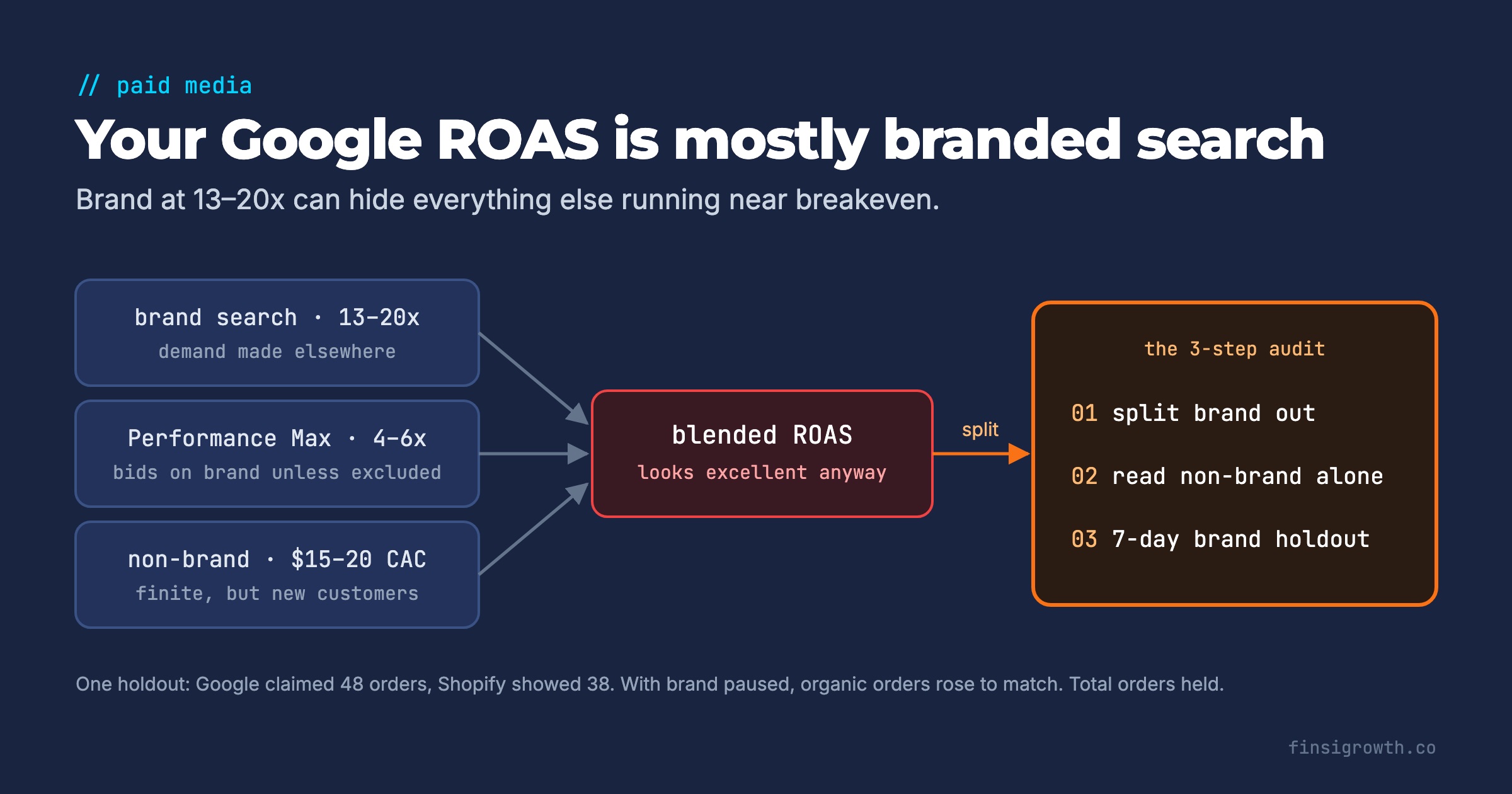
If your Google account reports 5x, the odds are good that one campaign is doing almost all of the work: branded search. People who type your name into Google already decided to buy. Meta, email, PR or a friend created that intent. Google collected it, and the blended number gives Google the credit.
Google captures demand. It can’t create it. So the only Google number that tells you whether to spend more is non-brand performance, read on its own. Below is the 3-step audit we run on every Google account: split brand out, read non-brand alone, and test brand with a holdout. Then we cover when paying for your own name is still worth it.
Key Takeaways
- Blended Google ROAS mixes three different engines: brand search, Performance Max/Shopping and non-brand search. Brand at 13–20x can hide everything else running near breakeven.
- Performance Max serves on your brand queries unless you stop it. Separate brand into an exact-match campaign and exclude it from PMax.
- Judge non-brand on its own CAC against your break-even CAC, using Shopify orders rather than Google-reported conversions.
- In a branded-search holdout we ran for a client, Google-attributed orders fell and organic orders rose by the same amount. Total orders held.
- Brand search is still worth paying for when competitors bid on your name, when you don’t rank first organically, or around PR and launch spikes. Cap it; don’t scale it.
Why does branded search inflate blended Google ROAS?
Branded search inflates Google ROAS because it bills you for customers who were already on their way to your site. The click is cheap, the conversion rate is high, and most of the demand came from somewhere else.
You can see it in the numbers from our client and discovery calls:
- An established tea brand told us in March 2026 that its Performance Max campaigns historically returned 4–6x, while brand search returned 13–20x. Put those in one account and the average looks excellent, whatever non-brand is doing.
- A frozen-dumpling brand described Meta and Google as “a sweet couple” (December 2025). Meta ads make people curious, those people search the brand name, and Google’s brand campaign claims the sale.
- A water-filtration brand found that PR articles drove spikes in branded search, which masked a Performance Max campaign that converted almost nothing. Its growth lead put it simply: the blended metric on Google “is actually fooling you” (July 2026).
- Several brands we work with see Google spend and conversions rise on email send days and launch days (March 2026). Nothing about Google changed on those days. The demand did.
The best public evidence is old but still the cleanest experiment on record. eBay switched off its brand-keyword ads on Microsoft and Yahoo search. About 99.5% of the lost paid clicks came back through organic results. The researchers concluded that brand-keyword ads had “no measurable short-term benefits” (Blake, Nosko and Tadelis, NBER Working Paper 20171, May 2014). eBay is a household name, so treat that as the extreme case. Your brand probably isn’t eBay. But the direction holds.
Where does Performance Max fit in?
Performance Max is the campaign that quietly absorbs your brand traffic. Left alone, it bids on branded queries and Shopping placements for your own products, then reports those sales as its own results. That makes PMax look like a prospecting engine when part of it is a brand campaign with a different name.
We see this often enough that we now separate brand search into its own exact-match campaign as a default setup step. Two clients went through that change in late August 2026: a coffee brand and a vinyl subscription club. In both, PMax was over-crediting itself with branded search.
A nutrition-shake brand showed us the opposite side of the same problem in June 2026. An earlier agency had let branded queries leak into its “cold” campaigns. Once negatives cleaned that up, brand search reported 6–9x, and PMax stood on its own at about $46 per conversion. Same account, same spend. The cleanup didn’t improve anything; it made the real numbers visible. The brand also found that raising the brand budget dropped ROAS “considerably,” which is what you’d expect from a campaign that’s already capturing most of the demand available.
Google gives you the control. You can apply brand exclusions to Performance Max so it stops serving on branded queries (Google Ads Help, brand exclusions). Use it.
Two growth leads we spoke with in July 2026 described Google as “three different engines bolted together”: brand, PMax and non-brand search. Each one needs its own scorecard.
| Engine | What it actually does | Judge it on | Typical warning sign |
|---|---|---|---|
| Brand search | Captures people already looking for you | Cost per conversion and impression share on your own name | ROAS above 10x being used to justify more total Google budget |
| Performance Max / Shopping | Mix of brand capture, retargeting and some new demand | Results with brand excluded, read in Shopify | ROAS drops sharply once brand exclusions go on |
| Non-brand search | Captures category intent (“best juice for sleep”) | New-customer CAC against break-even CAC | Spends well under budget in soft weeks |
The 3-step audit
The audit takes an afternoon. You need Google Ads access, Shopify, and your break-even CAC.
Step 1: Split brand out of everything
Pull the search terms report for the last 60–90 days across every campaign, including PMax’s search term insights. Tag every query that contains your brand name, misspellings, or your product names that only you sell.
Then rebuild the structure:
- One exact- and phrase-match brand campaign, with its own budget.
- Brand exclusions on every Performance Max campaign.
- A shared negative keyword list with your brand terms, attached to every non-brand search campaign.
Before you change anything, note how much of total Google conversions came from brand terms. That share is the first number to bring to your next budget meeting.
Step 2: Read non-brand on its own
Now look at non-brand search and brand-excluded PMax as if brand didn’t exist. Calculate ROAS and CAC for that slice only. Then compare CAC with your break-even CAC, the most you can pay for a new customer and still hit your payback period. If you don’t have that number yet, our break-even CAC guide walks through it.
Use Shopify orders, not Google-reported conversions, for the read. Platforms count differently, and Google’s numbers drift high. We covered how to reconcile the two in platform revenue vs. Shopify.
Expect non-brand to be smaller and harder than the blended number suggested. An organic juice brand we run Google for gives a clean picture of the ceiling. In one soft week in August 2026, Shopping spent only about 20% of its budget, and non-brand about 43%. Google wasn’t holding back. There simply weren’t enough searches. In the founder’s words: “We cannot generate demand on Google.” Earlier, that brand set a 5x target ROAS on PMax and Shopping and got about 3.2x in practice (July 2026).
None of this means non-brand is bad. Across brands we work with, Google search has run at roughly $15–20 CAC against about $30 on Meta (August 2026). It’s often the cheapest new customer you can buy. It’s just a finite supply, and it can’t be grown by adding budget.
One timing caveat for anyone running this audit now. Around the week of August 17, 2026, we saw Google change how target ROAS and target CPA bid. At one client, cost per conversion went from $25–30 to about $120 within two weeks. If your comparison window straddles that week, split it in two and read each half separately.
Step 3: Run a brand holdout
The only way to know what brand search adds is to turn it off and watch total orders. Not Google-attributed orders. Total orders.
We ran this for a client in July 2026. When brand search paused, Google-attributed orders fell, and organic search orders rose by almost exactly the same amount. Nothing was lost. Google had been claiming 48 orders for the period, against 38 in Shopify’s last-click view. Client results are specific outcomes, not typical or guaranteed.
How to set up your own:
- Run it for at least 7 days. The tea brand tried a one-day Google pause in March 2026 and couldn’t read it, because attribution lag smeared the results across the following days.
- Track the right metrics. Total orders, new-customer orders, organic plus direct sessions, and revenue. Ignore what Google reports during the test.
- Watch the search results page. Search your own name daily. If a competitor or reseller takes the top slot, that changes the answer (see the next section).
- Pick a normal week. No launches, no big email sends, no PR. Those spike brand demand and drown the signal.
- Run it the other way if you can’t pause. With the dumpling brand, we suggested doubling Google spend for a week to see whether total orders move. If doubling spend adds nothing, the spend wasn’t adding anything either.
Write down your decision rule before you start. For example: if total orders fall less than 3%, cap brand at a maintenance budget and move the savings to channels that create demand.
When is paying for your own name still worth it?
Paying for your brand is worth it when someone else would take the click if you didn’t. The 2011 Google research behind the “89% of paid clicks are incremental” claim (Chan et al., Google Research, 2011) has a follow-up that matters more for brand terms. Incrementality depends heavily on where you already rank organically.
When you already rank first for your own name, about half of your brand ad clicks would have happened anyway. That’s from the same Google team (Google Research, March 2012), measured on clicks, not purchases. Purchase incrementality can be lower still, since the most determined buyers will scroll past the ad to the organic link.
From our calls, four situations justify a brand budget:
- Someone else bids on your name. A gift subscription brand found a wholesale partner bidding on its brand keywords in Google Shopping with a cheaper listing. A competitor also showed up on its brand search (late 2025). A travel-goods brand noticed a much larger competitor eating its Google impression share only because someone happened to look on a Monday (August 2026). If you go dark, those listings take your clicks.
- You don’t own the top organic result. New brands, generic-sounding names, and brands outranked by marketplaces or review sites all sit in the 82–96% zone on the chart.
- Demand is spiking. PR hits, TV mentions and launches flood brand search for days. An at-home health-testing brand raised its brand budget to $1,500 a day to capture that demand. It also noted that cost per click is high on terms people already search (April 2026). Size the budget to catch the spike, then bring it back down.
- Peak season is budget-capped. The gift subscription brand got about 70% of the previous year’s Father’s Day sales from Google. Yet its branded search was limited by bid strategy, and campaigns by budget (June 2026). On a handful of peak days, losing your own top slot costs real orders.
| Situation | Brand budget decision | What to watch |
|---|---|---|
| You rank #1 organically, nobody else bids on your name | Cap at a small maintenance budget | Total orders during a holdout |
| Competitors or resellers appear on your brand query | Keep brand on, defend the top slot | Impression share and top-of-page rate |
| PR, launch or peak season | Raise the cap for those days only | Cost per conversion vs. normal weeks |
| Brand ROAS used to justify total Google spend | Separate it, report it apart from non-brand | Non-brand CAC vs. break-even CAC |
What brand search should never do is set the budget for the rest of Google. A 15x brand campaign tells you people like you. It says nothing about whether the next dollar in non-brand will pay back.
What to do this week
- Pull 90 days of search terms across all campaigns, PMax included. Tag every brand query and calculate brand’s share of Google conversions.
- Create an exact-match brand campaign with its own budget. Add brand exclusions to every PMax campaign and a brand negative list to non-brand search.
- Calculate non-brand CAC from Shopify for the last 30 days. Compare it with your break-even CAC. Write both numbers on one line.
- Search your own brand name on mobile and desktop, logged out. Screenshot who else shows up. Repeat on Monday and Friday.
- Schedule a 7-day brand holdout for a quiet week, with a written decision rule. If competitors already sit on your brand query, skip the holdout and defend the slot instead.
- Change the report. From now on, your weekly Google line shows brand and non-brand separately. Blended Google ROAS stops appearing on its own.
If you run Meta too, check that it isn’t quietly paying to reach people who’d buy anyway. Our Meta exclusion audit is the same idea applied to existing customers.
The decision this leaves you with
Brand search is a receipt for demand you created somewhere else. Pay for it when someone would steal the click, and cap it everywhere else. Then make every Google budget decision on non-brand numbers alone, against your break-even CAC. If non-brand can’t grow, the answer isn’t more Google. It’s more demand, created upstream, that Google can then collect.