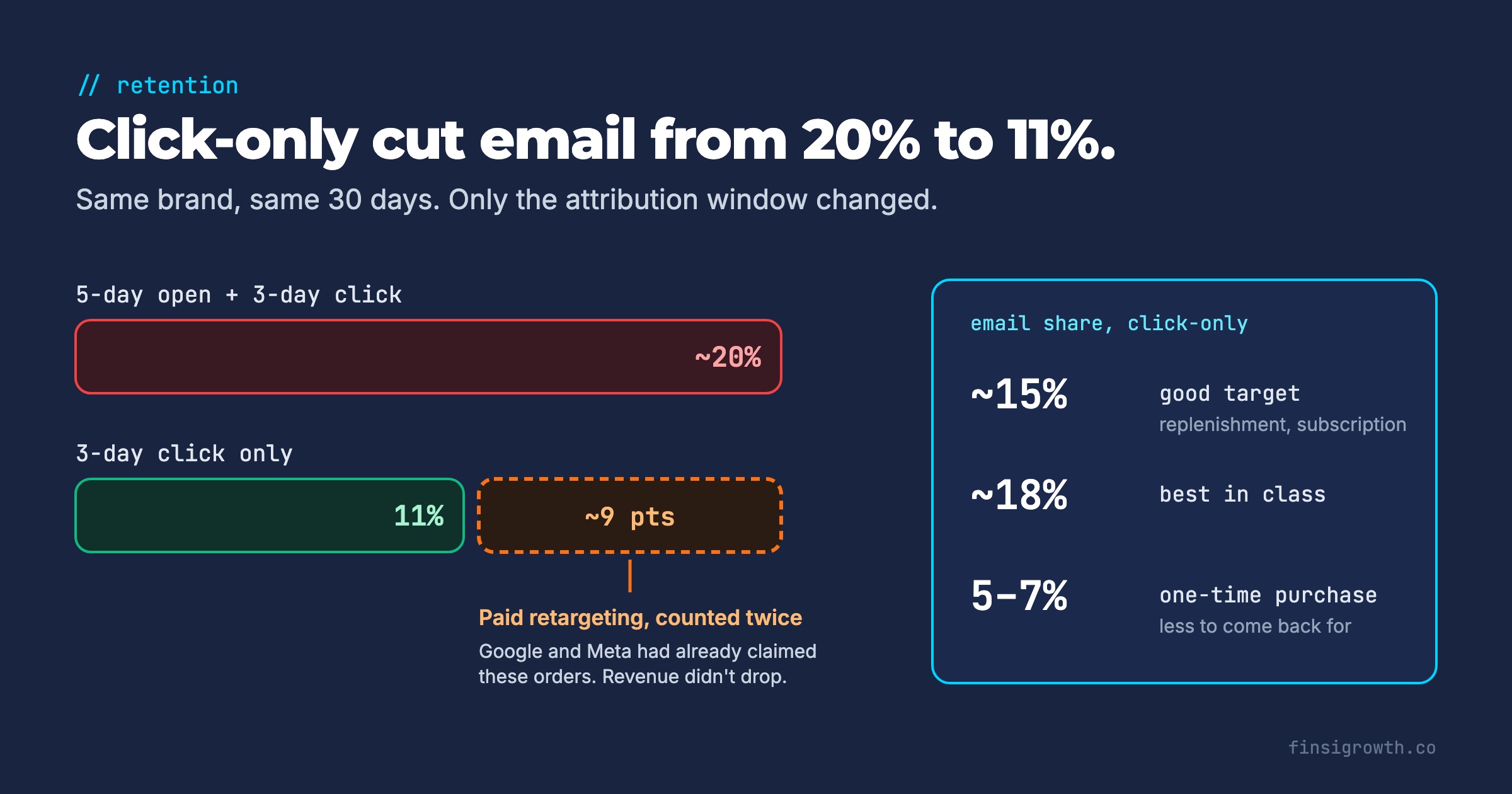
Klaviyo’s default setup gives email credit for any order placed within 5 days of someone opening a message. Apple’s Mail Privacy Protection can register opens nobody made, and subscription renewals land as ordinary orders. Put those together and your email revenue tile is partly a record of sales that would have happened anyway.
Switch email attribution to clicks only, inside a 2–3 day window, and take renewals out of the conversion metric. On one account we manage, that moved email from almost 20% of revenue to 11% over the same 30 days. The smaller number is the one to plan with. Then run a holdout, because even click-only attribution is a model. A holdout is a measurement.
Key Takeaways
- Klaviyo counts a conversion if someone opens or clicks within the window. For accounts created after October 9, 2024, the email default is 5 days.
- On one beverage brand, the same 30 days showed email at about 20% of revenue under the usual setup and 11% on 3-day click only. The gap was mostly paid retargeting.
- Renewals inflate email credit. At a tea brand, Klaviyo claimed 52% of revenue while Shopify credited email with about 32%.
- Under click-only attribution, we treat about 15% of revenue from email as a good target and 18% as best in class. One-time-purchase businesses run closer to 5–7%.
- The only real answer is a holdout: keep a random slice of your list out of campaigns for 6–8 weeks and compare Shopify revenue per person.
What does Klaviyo count as an email conversion by default?
Klaviyo credits a message when the recipient opens or clicks it and then places an order inside the attribution window. Its help center says “conversions are tracked if someone opens or clicks.” For accounts created after October 9, 2024, the default window is 5 days for email and SMS (Klaviyo Help Center, Understanding message conversion tracking, updated March 2026).
When Klaviyo rebuilt its attribution model, it let you set a window for opened emails separately from clicked emails. It also let you exclude Apple Mail Privacy Protection opens, noting that “some brands experience misleading attribution as a result” (Klaviyo, Introducing attribution model updates, August 2024).
Apple’s feature is the reason opens stopped being a clean signal. Mail Privacy Protection “helps users prevent senders from knowing when they open an email” (Apple Newsroom, June 2021). In practice, that means machine-loaded opens show up in your data. A founder we spoke to in May put it simply: a 50% open rate “seems like BS.” Usually it is.
So an open-based window rewards email for three things it didn’t cause:
- Machine opens. Privacy-protected inboxes register opens without a reader.
- Paid retargeting. Someone opens Tuesday’s email, ignores it, clicks a Meta retargeting ad Thursday and buys. Both channels claim the order.
- Renewals. A subscriber opens the newsletter, and their scheduled charge goes through two days later.
How much does the window change the number?
A lot more than most teams expect. Here’s what we’ve seen across client and discovery calls this year.
| Brand (anonymized) | What changed | Email’s share before | After |
|---|---|---|---|
| Beverage brand | 5-day open / 3-day click → 3-day click only, same 30 days | Almost 20% of revenue | 11% |
| Tea brand | Klaviyo attribution vs Shopify’s last non-direct click | 52% (Klaviyo) | ~32% (Shopify) |
| History subscription brand | 5-day open → 2-day click | Not measured yet | Expected to “drop drastically” |
Client results are specific outcomes, not typical or guaranteed.
On the beverage brand, the gap between 20% and 11% wasn’t lost revenue. When we traced it, the difference was Google and Meta, “which actually retargeted these people.” The orders still happened. They just stopped being counted twice.
The tea brand’s gap had a second cause. Its Klaviyo conversion metric was the standard Placed Order event, which counts subscription auto-renewals. Every subscriber who opened a campaign before their renewal date handed email a sale. The team built a custom metric to exclude renewals. We covered the cross-platform version of this problem in platform math vs bank math.
Single sends can be absurd. One founder told us Klaviyo credited “$17,000 worth of attributed revenue” to a mediocre Tuesday email. The actual driver was a product drop that weekend. A book-and-coffee subscription box saw its email platform credit one send with about $20,000 because renewals happened to fall inside the window.
Why does open-based credit flatter email agencies?
Because a generous window turns paid media and renewals into email revenue, and email revenue is what agencies report. That’s rarely fraud. It’s the default setting doing what it was built to do.
The pattern shows up in founder stories:
- At one account, a previous agency’s big email revenue turned out to be “literally Facebook retargeting.” Once attribution switched to clicks, the client saw email wasn’t really making money.
- A founder told us their platforms reported $27,000 in revenue that we could verify only a fraction of. An agency had emailed 30,000 people and produced 5 sales.
- A book box founder described a brand whose email agency “revenue” came almost entirely from the signup pop-up. Campaigns produced one or two orders in six months.
- A nutrition retailer’s agency claimed email drove 20–30% of revenue. Franchise store sales were inflating the base the claim was built on.
If you pay an agency on attributed email revenue, the attribution window is part of their compensation plan. Our breakdown of DTC agency fee models covers why that matters. Set the window before you sign, and write it into the contract.
Is click-only attribution too harsh?
Sometimes, and that’s fine. Click-only is a floor, not the truth. Some people read an email, close it and type your URL an hour later. Click-only won’t credit those orders.
One apparel brand told us they think Klaviyo under-reports email, at 20% reported versus about 30% they believe is real. That can happen, especially for brands with strong content emails and weak paid retargeting. But belief isn’t measurement. Click-only gives you a conservative number you can defend. A holdout tells you whether the real figure is higher.
The direction of error matters. An open-based window over-credits email in a way that changes budget decisions. Teams cut paid prospecting because email “drives 40% of revenue,” then wonder why new customers dry up. A click-only number under-credits email slightly, and the cost of that is small. Other operators land in the same place. A functional supplement brand we work with runs its ad platforms on 1-day click only, for the same reason.
How do you switch Klaviyo to click-only?
It takes about 15 minutes in Klaviyo’s attribution settings, plus one custom metric. Change it at the start of a month so your reporting has a clean before and after.
- Remove opens as a touchpoint. If your account doesn’t allow removing them, set the opened-email window as short as it goes and exclude Apple Mail Privacy Protection opens.
- Set the clicked-email window to 2–3 days. We use 2 days for agency-managed accounts and 3 days for longer-consideration products. Pick one and keep it.
- Exclude bot clicks. Klaviyo lets you remove bot clicks from attribution. Check that yours are excluded.
- Swap the conversion metric to non-recurring orders. Klaviyo now documents a non-recurring placed order metric, or a custom metric that excludes recurring subscription contract orders. In one example, a review-request flow appeared responsible for £8,000–£9,000 of about £11,000 in flow revenue before renewals were filtered out (Klaviyo, Non-recurring placed order rate, March 2026).
- Annotate the change. Write the date in your weekly report. Email revenue will drop overnight, and someone will ask why.
- Report flows and campaigns separately. Flows react to customer behavior, so they usually hold up better under strict attribution. Campaigns are where generous windows hide the most.
What should email earn once attribution is honest?
Under click-only attribution with renewals excluded, these are the working targets we give clients for email’s share of total revenue:
| Business type | Email share of revenue (click-only) | Read it as |
|---|---|---|
| Replenishment or subscription, healthy list | About 15% | Good. Use it as the north star. |
| Same, best in class | About 18% | Hard to beat without over-mailing. |
| One-time-purchase products | 5–7% | Normal. Customers have less to come back for. |
| Well above these ranges | Check the setup first | Often opens, renewals or paid retargeting in the number. |
Compare those to the shares founders quote without saying how they’re measured. We’ve heard 34%, 40% and close to 70%, the last from a brand in a restricted ad category where paid channels barely exist. None of those are comparable until you know the window, whether opens count and whether renewals are excluded.
Retention isn’t sending more campaigns. A tea brand dropped its midweek campaign send. Flows went from about 10% of its email revenue to about 30%. Behavior-triggered messages for win-back, browse and replenishment usually carry email’s real contribution. That ties directly to retention rate and LTV, which is where email should be graded. Getting customers to the third order is a better email KPI than attributed revenue.
How do you run an email holdout?
Hold a random slice of your list out of campaigns, keep everything else the same, and compare Shopify revenue per person between the groups. Platform attribution doesn’t enter into it. That’s what makes it a real measurement.
A practical design for a $1M–$20M brand:
- Pick the population. Start with engaged subscribers who have bought before. That’s where campaign revenue claims are biggest.
- Split randomly. Tag profiles odd or even by customer ID, or use a random number property. A deodorant brand we spoke to ran gift-with-first-order tests this way, with Shopify Flow tagging customers odd and even. Avoid hand-picked groups.
- Size the holdout at 10–20%. Smaller groups need longer to read. Larger ones cost more if email is genuinely working.
- Exclude the holdout from campaigns only. Keep order confirmations, shipping notices and subscription reminders running for everyone. Hold flows constant, or test them separately later.
- Run it 6–8 weeks. Cover at least one full purchase cycle for your product and avoid launch weeks and big sales.
- Measure in Shopify, not Klaviyo. Compare revenue and orders per profile across all channels, plus unsubscribes and deliverability in the mailed group.
- Calculate lift. Revenue per mailed profile minus revenue per held-out profile, times the number of mailed profiles. That’s what campaigns actually added. Compare it to what click-only attribution claimed for the same period.
If the lift is close to the click-only number, keep using click-only as your weekly read. If it’s well above, email earns more than strict attribution shows, and you can say so with evidence. If it’s near zero, you’ve found hours you can spend on flows and segmentation instead.
What to do this week
- Write down today’s number. Record email’s share of revenue under your current settings for the last 30 days.
- Pull Shopify’s view. In Shopify’s attribution report, note email’s share under last non-direct click for the same 30 days.
- Change the settings. Remove opens (or set the shortest open window and exclude Apple privacy opens), and set clicks to 2–3 days.
- Exclude renewals. Set up the non-recurring placed order metric, or a custom metric, as your email conversion event.
- Re-run the 30 days. Compare the three numbers: old Klaviyo, new Klaviyo and Shopify. Share the gap with whoever approves the email budget.
- Schedule a holdout. Tag 10–20% of engaged buyers as a holdout, starting with your next non-sale month.
- Check your agency contract. If fees or bonuses depend on attributed email revenue, name the attribution window in writing.
Frequently Asked Questions
Will switching to click-only lower my email revenue?
Your reported email revenue will drop, often by a lot. Your actual revenue won’t change, because you’re only changing who gets credit. On one account, the same 30 days went from about 20% to 11% of revenue.
Should SMS use click-only attribution too?
SMS has no open signal to worry about, but Klaviyo can credit SMS on delivery. Use a short click window for SMS as well, and hold it to the same holdout test.
Is 2 days or 3 days the right click window?
Either is defensible. Use 2 days for impulse and lower-priced products, and 3 days where people compare before buying. Consistency matters more than the choice, so don’t change it between reports.
Email doesn’t need a generous window
Good email programs survive strict attribution. If yours only looks strong with a 5-day open window and renewals counted, you’re not looking at email performance. You’re looking at a default setting. Tighten the window, run the holdout, and give email the credit it can prove.