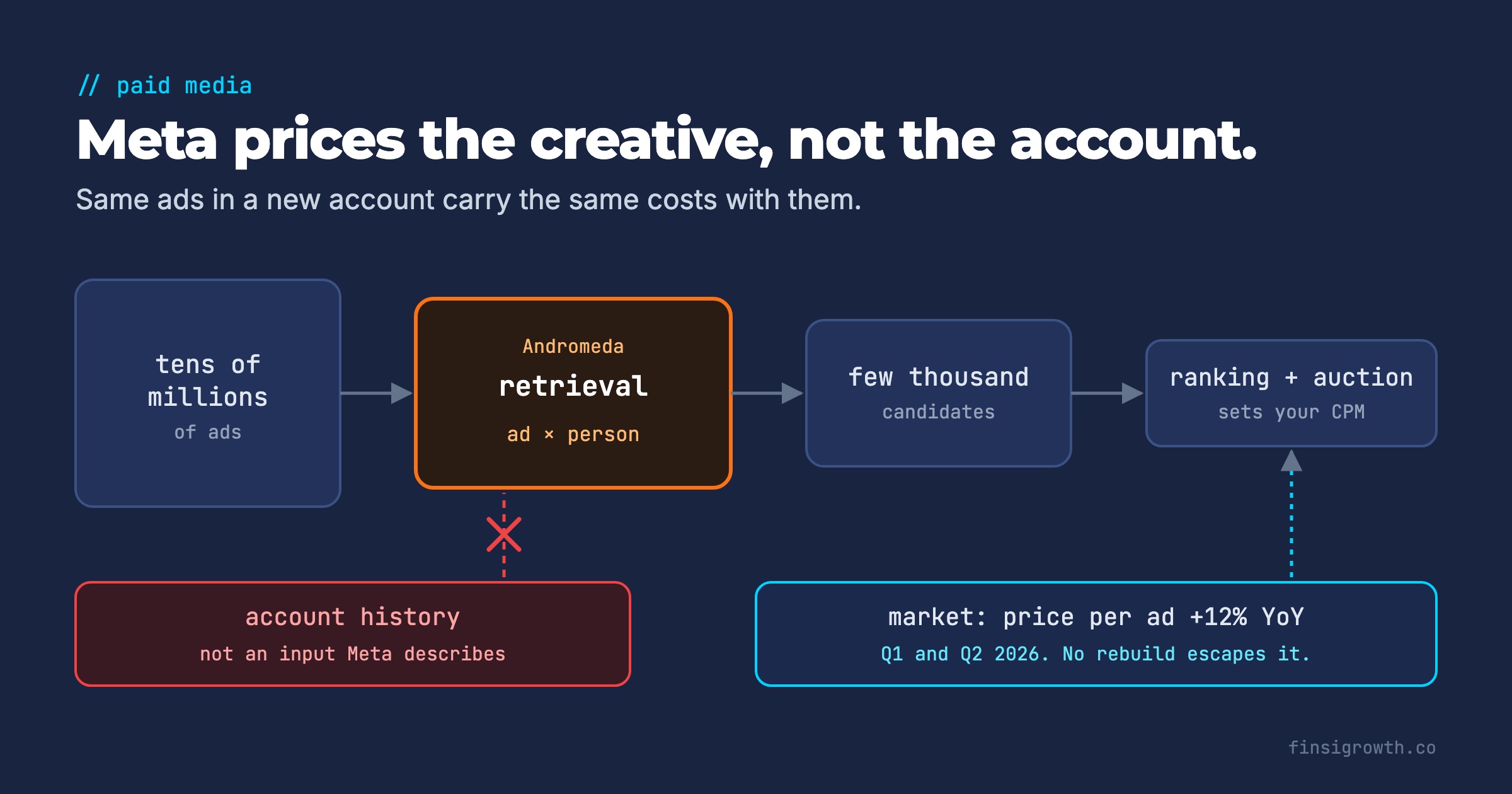
In every media buying community right now, someone is tearing down their Business Manager and rebuilding it to escape rising CPMs. The same ads go into the new account, and within a couple of weeks the CPM is right back where it was.
Our read is that the account was never what was being priced. The creative was, and it moved with them.
Think of a restaurant that moves to a new building with the same menu. The reviews follow the food. In this guide we cover what Meta’s Andromeda system actually does, what’s confirmed and what’s practitioner belief, how much of your CPM increase is simply the market, and what to change instead of the account.
Key Takeaways
- Andromeda is Meta’s ad retrieval engine. It picks which ads are even candidates before ranking and the auction, and it works from the ad and the person, not from your account’s history.
- Meta says its guidance is to diversify creative by concept and format. Practitioners go further and believe near-identical ads get treated as one ad. Meta hasn’t confirmed how its models represent creative.
- Part of your CPM rise is market-wide. Meta’s average price per ad was up 12% year over year in both Q1 and Q2 2026. No rebuild escapes that.
- Rebuilding to get around an enforcement action breaks Meta’s Account Integrity rules. Rebuilding for CPM alone isn’t banned, but it rarely fixes anything.
- Before touching the account, count how many genuinely different concepts you’re running. That number is usually the real problem.
Why do media buyers rebuild their ad accounts?
They rebuild because they believe the account itself carries a bad history that the auction punishes. For years that was a reasonable belief: accounts that had been restricted, flagged or run badly often seemed to stay expensive, and a fresh start sometimes looked like it helped.
The logic goes: CPMs went up, nothing obvious changed in the ads, so something about the account must have gone bad. Tear it down, start clean, and the penalty disappears.
The problem is what happens next. The new account gets the same ads, the same landing pages and the same offers. If CPM comes back after a few weeks, the account wasn’t the variable. Whatever was being priced made the move too.
Worth knowing: we found no Meta documentation saying account history affects ad pricing, or that a new account resets it. That belief is community lore, not a stated mechanism.
What is Meta Andromeda?
Andromeda is Meta’s ad retrieval engine: the step that narrows tens of millions of possible ads down to a few thousand candidates for each person, before the ranking models and the auction decide what actually shows. Meta described it in a December 2024 engineering post, reporting a 6% recall improvement in retrieval and an 8% ads quality improvement on selected segments.
Two things in that post matter for this argument.
- Retrieval is personalized to the ad and the person. Andromeda’s job is matching individual ads to individual people. Your Business Manager’s age isn’t an input Meta describes anywhere.
- It was built for a flood of creative. Meta wrote that the number of ad creatives in its systems is “expected to grow significantly” as generative AI tools spread, noting that more than a million advertisers had used its GenAI tools to create over 15 million ads in a single month.
So before your ad ever reaches the auction, a system has already decided whether it’s worth considering for this person. If the ad doesn’t get retrieved, a cleaner account doesn’t help it.
Does Meta price creative similarity?
Meta hasn’t said so directly, and we want to be careful here. What’s confirmed is the direction of Meta’s guidance. What’s believed is the specific mechanism.
| Status | Source | |
|---|---|---|
| Meta recommends diversifying creative “by concept and format” | Official | Meta Blueprint course |
| Ads Manager has a “Creative diversity” rating for ad sets (Low, Medium, High) | Official, labeled estimated and in development | Meta Help Center; launch reported Aug 26, 2026 by Common Thread Collective |
| Near-identical ads get treated as one ad | Practitioner belief | Agencies quoted in Marketing Brew, Sep 28, 2026 |
| ”Entity IDs” or a fixed similarity percentage | Unverified | No Meta source found |
The Marketing Brew piece captures the gap well. An agency creative lead said ads sharing the same look or opening hook get read as duplicates: “The engines will see it as fundamentally the same ad.” Meta’s spokesperson in the same article declined to go that far, saying the company doesn’t “get into the specifics of how our ranking models represent individual creative assets,” and describing its guidance as “deliberately outcome-based.”
Here’s why practitioners connect this to CPM. If ten of your ads look and open alike, the system effectively has one idea to work with, not ten. One idea reaches the people it suits, keeps reaching them, and gets more expensive to show as it fatigues. Adding nine more copies doesn’t add reach. It adds the same fatigue.
That’s an inference, not a published rule. But the pattern shows up often enough, and it lines up with Meta’s own guidance, so we’d plan around it.
How much of your CPM increase is just the market?
A meaningful part of it. Meta’s average price per ad rose 12% year over year in Q1 2026 (Meta Q1 2026 results) and again 12% in Q2 2026 (Meta Q2 2026 10-Q), up from 6% in Q4 2025 (Meta Q4 2025 results).
Two caveats. “Average price per ad” is a blended number across every advertiser, placement and region, so it isn’t your CPM. And Meta is showing more ads at the same time (impressions up 14% in Q2), so prices are rising even as supply grows. Demand for attention on Meta is going up.
The practical point: if your CPM is up roughly 10–15% year over year, you may simply be tracking the market. A new account can’t escape a market-wide price. If your CPM is up 40%, something specific to your ads is more likely, and creative is the first place to look.
Is rebuilding your ad account against Meta’s rules?
It depends why you’re doing it. Meta’s Account Integrity standard lets it restrict or disable business assets “created or repurposed to evade a previous account or entity removal,” including ones it judges to share ownership and content with removed accounts.
So rebuilding after a restriction, with the same ads, is the exact pattern Meta looks for. It risks losing the new account too, and taking your Page or pixel with it.
Rebuilding purely because CPMs went up, with no enforcement history, isn’t prohibited as far as we can find. It’s just usually pointless. You lose your setup, your audiences and your reporting history, and you keep the thing that was driving the cost.
What should you do instead of rebuilding?
Fix the portfolio, not the container. Here’s what we’d run this week.
1. Check the Creative diversity column. In Ads Manager, add the Creative diversity rating to your ad set view. Meta labels it estimated and in development, so treat a “Low” as a flag to investigate, not a verdict.
2. Count concepts, not ads. Export every active ad and tag each one by its core idea: the angle, the opening hook, the first frame, the format and who’s on screen. Then count distinct combinations.
| What you see | What it usually means |
|---|---|
| 40 active ads, 4 concepts | You’re running 4 ads with costume changes. Expect fatigue. |
| Most variations differ only by headline or color | Practitioners would say the system sees these as one ad. |
| One concept carries most of the spend | Normal, but you need the next concept in testing now. |
3. Brief genuinely different concepts. “Different” means a new reason to buy, not a new caption. A founder story, a customer problem, a product demo, a comparison and a review compilation are five concepts. The same demo with five hooks is closer to one.
4. Test in the account you already have. Launch a batch of new concepts and compare their CPM and cost per purchase against your existing ads over two weeks. If new concepts come in cheaper in the same account, you’ve learned the account was never the problem. If you decide to judge individual ads, our guide on when to kill or scale a Meta ad covers how much spend each one needs first.
5. Judge the result on economics, not CPM. A higher CPM is fine if the people you’re reaching buy. Watch cost per purchase, new-customer CAC and account-level MER together. A concept with a 30% higher CPM and a 20% lower CPA is a winner.
Why CPM isn’t the number to manage
CPM is a price. Payback is the decision. The brands that get stuck rebuilding accounts are usually the ones staring at CPM in isolation.
What matters is whether a new customer pays back their acquisition cost within the window you can afford. That comes from contribution margin per order and how quickly customers come back, not from what you paid per thousand impressions. A brand with strong repeat purchase can carry a higher CPM than a competitor and still win the auction profitably. That’s why we look at payback period before CPM.
For the account-level view of when to push spend and when to pull back, see the e-commerce scaling scorecard. If you’d rather have your creative portfolio and payback numbers reviewed together every week, that’s part of what Finsi Growth does for DTC brands.
Frequently Asked Questions
Does a new Meta ad account get lower CPMs?
Sometimes for a short while, but there’s no Meta documentation saying new accounts are priced differently. If the same ads go in, the same costs tend to return once delivery stabilizes. Treat any early dip as noise until it holds for a few weeks.
What is Andromeda in Meta ads?
Andromeda is Meta’s ad retrieval engine. It narrows tens of millions of possible ads to a few thousand candidates for each person before ranking and the auction. Meta introduced it in a December 2024 engineering post.
How different does a new ad need to be to count as a new creative?
Meta hasn’t published a threshold, and claims about a specific similarity percentage don’t trace back to Meta. Aim for a different concept: a new angle, a different opening and ideally a different format. Headline or color swaps on the same video are unlikely to count.
Is it against Meta’s rules to create a new ad account?
Creating a new account isn’t against the rules on its own. Creating one to evade a previous removal or enforcement action is, under Meta’s Account Integrity standard, and Meta may restrict assets it believes share ownership and content with removed ones.