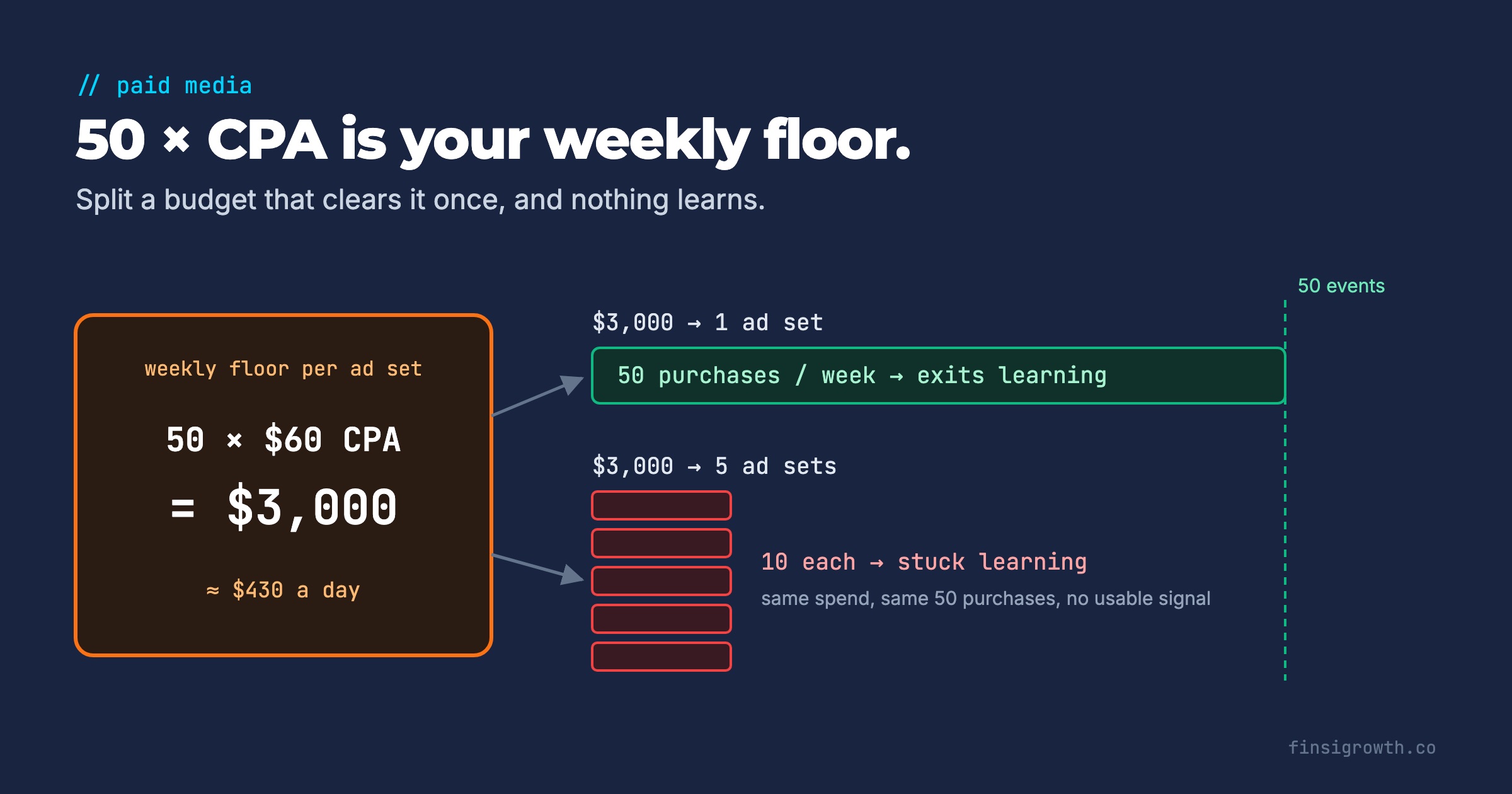
Meta’s delivery system needs about 50 optimization events per ad set in the week after a significant edit before it stops “learning.” Multiply 50 by your cost per purchase and you get the weekly spend floor for one ad set. At a $60 CPA, that’s $3,000 a week, or roughly $430 a day, for a single ad set optimizing for purchases.
Many small accounts we audit spend less than that and split it across four, five or ten ad sets anyway. None of them reach the threshold, so every CPA and ROAS number in the account is built on a handful of random purchases. That isn’t testing. It’s noise with a dashboard on top, and the fix is structural, not creative.
Key Takeaways
- Meta says ad sets usually exit learning after about 50 optimization events in the week after their last significant edit. Your weekly floor per ad set is 50 × CPA.
- Splitting a budget that only clears the floor once guarantees that nothing clears it. Two ad sets at half budget means two ad sets stuck learning.
- With a few conversions per ad, a 5.6 ROAS and a 2.8 ROAS can be the same ad. One higher-priced purchase made the difference in an account we reviewed.
- The small-budget rule set: one evergreen campaign with 70–80% of spend on proven ads, a separate test budget, about one new creative a week, and ~20% budget steps.
- Pausing everything, relaunching, or dropping seasonal creative into your evergreen campaign resets learning. Each reset costs you another week of noisy spend.
What does Meta actually say about the learning phase?
Meta describes the learning phase as the period when its delivery system is still working out how an ad set should deliver. Ad sets usually leave it “after about 50 optimization events in the week after the ad set’s last significant edit” (Meta Business Help Center, About the learning phase, March 2025 version). Shops ads have a lower bar of 17 website purchases plus 5 on Meta, but most DTC brands aren’t optimizing for that.
The same page lists four practices. Paraphrased:
- Don’t edit during learning. Editing an ad, ad set or campaign resets learning and delays optimization.
- Avoid unnecessary edits. Changes that meaningfully alter how the ad set might perform send it back into learning.
- Avoid high ad volumes. More ads and ad sets means the system learns less about each one. Combining similar ad sets combines their learnings.
- Use realistic budgets. A budget too small to generate enough optimization events, or frequent budget changes, works against exiting learning.
When an ad set can’t reach the threshold, Ads Manager labels it “Learning limited.” The usual causes, per Meta: small audience, low budget, low bid or cost control, high auction overlap, an infrequent optimization event, or too many ads at once. Its first suggested fix is to combine ad sets and campaigns (Meta Business Help Center, About learning limited, February 2025 version).
Meta also says learning limited “isn’t a penalty.” True, but it is a diagnosis. It means the system can’t tell good results from lucky ones with the data you’re giving it.
How do you calculate the weekly budget floor?
Weekly floor per ad set = 50 × your cost per optimization event. For purchase-optimized campaigns, that event is a purchase, so use your realistic CAC or cost per purchase. Then divide by seven for a daily number.
| Cost per purchase | Weekly floor per ad set | Daily equivalent | Monthly equivalent |
|---|---|---|---|
| $20 | $1,000 | ~$143 | ~$4,300 |
| $30 | $1,500 | ~$214 | ~$6,500 |
| $40 | $2,000 | ~$286 | ~$8,700 |
| $60 | $3,000 | ~$429 | ~$13,000 |
| $90 | $4,500 | ~$643 | ~$19,500 |
Monthly figures use 4.33 weeks per month.
Two things fall out of this table.
First, the number of ad sets you can run is a budget fact, not a strategy choice. Divide your weekly Meta budget by the floor. A $6,000-a-week account at a $60 CPA can support two purchase-optimized ad sets that learn properly. Not six.
Second, some accounts can’t fund even one. One subscription brand we work with spent around $8,000 a month on Meta, with a CAC near $60. At that CPA, one ad set needs roughly $13,000 a month to clear the bar. Every ad set in that account is learning limited by arithmetic, before anyone looks at creative.
When we walked a vinyl subscription club through this math in December, the conclusion was blunt. At a $60 CAC, you need about $3,000 a week to get one holiday ad set out of learning. Their holiday ad set sat in learning limited at around $90 per result.
Why does splitting the budget kill learning?
Because the 50-event threshold applies per ad set, not per account. Split a budget that clears the floor once into five pieces and each piece gets 10 events a week. The account still buys 50 purchases, but Meta has five weak signals instead of one usable one.
We’ve seen three versions of this split in client and discovery calls over the past few months.
Tests starving inside the evergreen campaign. A dog subscription box had new test creatives sitting in the same campaign as its proven evergreen ads. Meta pushed spend to the proven ads, so some test creatives got $37–45 in 30 days against a $65 CAC. That’s “not enough even to get one conversion,” as we put it on the call. Two separate promo campaigns ran on $500 a month each and produced 8–10 results apiece. Neither could ever learn.
Micro-budgets that never had a chance. A history-letter subscription brand had almost every ad set in learning limited. One ad was running on $5 a day. At their CPA, that ad would need months to collect a week’s worth of learning events.
The same ads duplicated across audiences. That brand’s prospecting setup ran the same five ads in two ad sets. That’s ten ads, splitting both delivery and signal. Unless you’re running a deliberate A/B test, duplicating identical ads across ad sets halves the data behind each one.
How noisy are results below the threshold?
Very. When an ad has two or three purchases, a single order moves its ROAS by multiples.
In a December review of that history-letter account, two ads showed ROAS of 5.6 and 2.8. The gap came from one higher-priced purchase. Two other ads showed cost per purchase of $20 and $64, each on two conversions. On a dashboard, that looks like a clear winner and a clear loser. Statistically, it’s a coin toss. We called it “basically gambling” on the call, and that’s the right frame.
The practical consequence: below the floor, you can’t tell creative quality from luck, so most “optimizations” are reactions to noise. Founders then cut ads that were fine and scale ads that got lucky.
Do you really still need 50? Isn’t 20 enough now?
We hear this often. In November, a media buyer at one client’s agency argued that Meta’s algorithm had changed and about 20 conversions now suffice. Meta’s own help pages still say about 50, and we haven’t seen a Meta source saying otherwise.
Our working rule is stricter on interpretation than on the number. If an ad set hasn’t exited learning within about a week, treat that as a signal it isn’t working. In September, a vinyl club had an ad that brought 20 purchases and was still learning limited. Twenty purchases spread over random audiences don’t tell Meta, or you, who the buyer is.
What resets learning without you noticing?
Any significant edit restarts the clock, and the expensive resets are usually self-inflicted. These are the ones we’ve seen cost brands a week or more of spend:
| What happened | Result | Seen at |
|---|---|---|
| Agency shut off all campaigns and relaunched with new ads | Every active ad set back in learning | Dog subscription box, Oct 2025 |
| Swapped a Halloween promo for a fall promo in the same campaign | Whole campaign back in learning | Dog subscription box, Oct 2025 |
| Added Valentine’s creatives to the evergreen campaign | Account back in learning; CTR dropped | Dog subscription box, Feb 2026 |
| Moved a winning ad into the main ad set | The winner’s spend stopped | Book-and-coffee subscription box, Feb 2026 |
| Ran short flash sales instead of month-long promos | High CAC; the brand moved to month-long promos | Dog subscription box, Aug 2025 |
Client results are specific outcomes, not typical or guaranteed.
The pattern is the same each time. Someone treats the account like a storefront window, swapping everything for the season, when Meta treats each change as a new experiment that needs its own 50 events.
What’s the right structure for a small Meta budget?
Size the structure to the floor, then protect the ad sets that are learning. These are the rules we run on small accounts, all drawn from calls with brands spending a few thousand dollars a week or less.
- One evergreen campaign holds 70–80% of spend on proven ads. Never turn everything off at once. Keep at least one proven ad running through every change.
- Tests get their own campaign and budget. If tests share a campaign with proven ads, Meta starves them. A separate budget is the only way a new creative gets a fair look.
- Seasonal and promo creative goes in its own campaign. Don’t drop Valentine’s or Black Friday ads into the evergreen campaign. You’ll reset the thing that pays your bills.
- Launch about one new creative a week. At small budgets, more than that splits spend below the floor. Launch midweek; in two accounts Monday and Tuesday ran weak, so reading results by Friday was cleaner.
- Kill on spend, not days. Our rule: an ad that has spent about 3× your target CAC with zero purchases gets cut.
- Scale in ~20% steps. In December we told the vinyl club to raise evergreen by 20%, not 50%. Meta warns that frequent budget changes can trigger learning again, and it doesn’t publish a safe percentage. Twenty percent is a practitioner rule, not a Meta number.
- Prefer longer promos. The dog box moved from flash sales to month-long promos so each campaign could actually finish learning.
- Respect launch cutoffs before peaks. Before Black Friday last year, we set November 7 as the last day to launch anything new. After that, only budgets moved.
If you genuinely can’t afford 50 purchases a week in even one ad set, Meta suggests optimizing for a more frequent event, such as add to cart. That trade has a cost. You’ll exit learning, but you’re now teaching Meta to find people who add to cart. Check that against purchases in Shopify, not just in Ads Manager. Our platform-vs-Shopify reconciliation walks through that check.
How does this connect to your unit economics?
The floor is a cash commitment, so it has to pass the same test as any other spend. A $3,000 weekly floor at a $60 CAC only makes sense if a $60 customer pays back inside your payback period. If the first order loses money on contribution margin, you’re paying to learn who your unprofitable customers are.
That’s also why we don’t recommend cutting Meta to near zero in slow months. Restarting from scratch means paying for learning again. Our January ad spend post covers why Q1 is often a better time to hold spend than to pull it.
Judge the account at the level where the math works: blended new-customer CAC and MER across the whole account, weekly. Individual ad-level numbers below the floor are inputs to watch, not verdicts to act on.
What to do this week
- Pull your real CPA. Use the last 28 days of cost per purchase, or better, spend divided by new customers from Shopify.
- Calculate the floor. Multiply by 50. That’s the weekly spend each purchase-optimized ad set needs.
- Count your ad sets. Divide weekly Meta spend by the floor. If you have more active ad sets than the result, you’re over-split.
- Check the Delivery column. List every ad set marked “Learning” or “Learning limited” and its weekly spend versus the floor.
- Consolidate. Merge similar ad sets into one evergreen campaign with 70–80% of budget. Move tests into their own campaign with a dedicated budget.
- Freeze edits. For the next seven days, change nothing in the evergreen campaign except budget, in steps of about 20%.
- Write down your kill rule. About 3× target CAC spent with zero purchases. Stick to it.
Meta’s learning phase isn’t a mystery. It’s a sample-size requirement with a price tag. Pay it in one place and you get a signal. Spread it thin and you’re paying for noise.