Small DTC teams rarely fail because they can’t see their numbers. They fail because they can see too many of them, and every number comes with a recommendation nobody has the hours to run. The constraint isn’t insight. It’s execution capacity.
The fix is blunt. Pick two priorities a month and size each one in dollars and hours. Give each a single owner, and write everything else onto a “not now” list. Below is how we’ve seen that play out across our client and discovery calls from mid-2025 through January 2026, and a scoring method you can run on Friday.
Key Takeaways
- On our calls, the most common complaint from brands under about $10M wasn’t missing data. It was recommendations piling up unexecuted.
- A long to-do list behaves like no list at all. Teams start a third of a task, then it slips to next month.
- Score each candidate by estimated monthly dollar impact, times your confidence, divided by owner-hours. Then take the top two.
- One owner per priority, a time box of about two weeks, and a written keep-or-kill rule before you start.
- Dashboards are for noticing. Priorities are for deciding. Don’t let the first job eat the second.
Why do more insights make small teams slower?
Because every insight is a claim on someone’s week, and a small team has maybe five free hours in that week. More insight past that point doesn’t add progress. It adds guilt.
We’ve heard this in almost the same words from very different brands:
- A history-subscription founder, mid-2025: “I don’t need more ideas. I just need a little bit more time to implement.”
- A vinyl record club founder, in October: “you guys give me great insights every call, and I never get a chance to do them.” Site recommendations from two weeks earlier were still untouched.
- A founder of a data-connector startup that works with consumer brands: “A long laundry list of to-do items is equally as unhelpful as not knowing anything.”
- A book-and-coffee subscription operator, newer to e-commerce: “seeing all of those can be really overwhelming.”
And we said it ourselves. On a September call with a two-person pet subscription team, we admitted a hard truth. We were producing insights faster than the team could act on them. That’s the honest diagnosis for most brands under $10M. A post-purchase survey vendor we spoke with put it more sharply: brands below that size often “don’t even know what to do with” their analytics.
None of these teams were lazy or uninformed. They were running ads, customer service, inventory and email with two or three people. The problem was the ratio of recommendations to hours.
What does insight overload actually cost?
It costs a quarter where everyone was busy and nothing changed. In October we described it to a snack-brand founder as “death by a thousand cuts… end of quarter, no progress, but you’ve been busy.”
The pattern has a recognizable shape:
- Half-finished tasks. An online growth lead at a haircare and bodycare brand told us that important fixes “never bubble to the top… get through a third of the task, and then it’s for another month.” Site speed is the classic example. Someone compresses three images, then the week ends.
- Big projects nobody starts. A coffee-equipment brand had no win-back campaign at all. It looked like an “intimidatingly large workflow,” and “nobody has the time.”
- Everything routes through the founder. The history-subscription founder read our weekly report and said: “Yes, we should do that… who’s going to do that, and who’s gonna see it through the finish line?” A month later: “nothing moves without me.”
- More reporting as a substitute for action. The snack-brand founder was blunt about it: “I’m not gonna get anywhere with more reporting.”
There’s a hidden cost too. When recommendations sit unexecuted, nobody learns whether they were right. You end the quarter with the same open questions and a longer list.
| Symptom | What it looks like | What fixes it |
|---|---|---|
| The laundry list | 15+ open recommendations, none owned | Cap active priorities at two |
| The one-third task | Work starts, then slips a month | Size tasks to the hours actually available |
| Founder bottleneck | ”Nothing moves without me” | One named owner per priority who isn’t the founder, where possible |
| Unmeasured changes | Things ship but nobody checks the result | Write the keep-or-kill rule before starting |
| Fear-driven backlogs | An audit says “everything’s broken” | Rank by dollars, not by alarm |
How do you pick the two priorities?
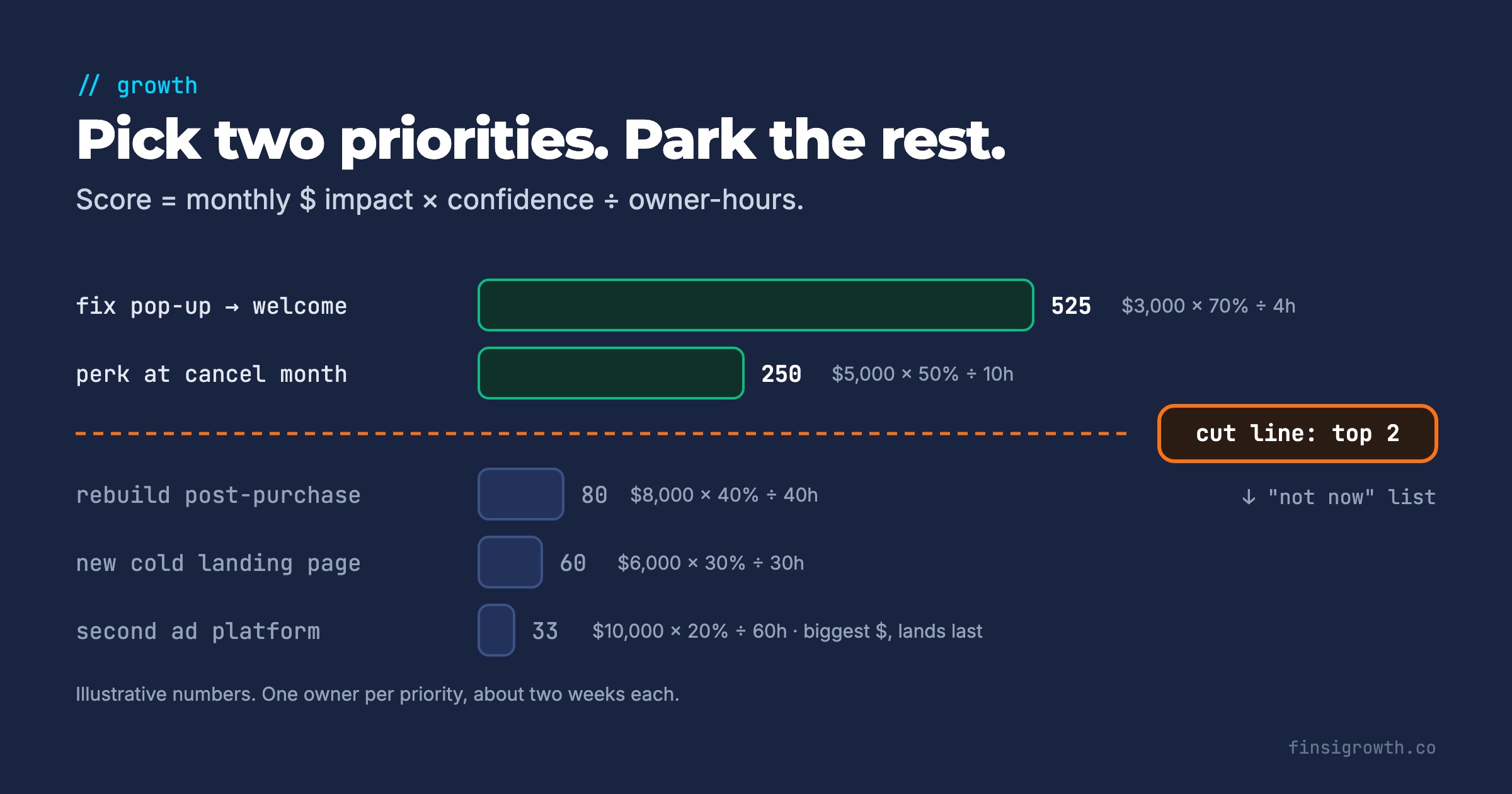
Score every candidate by expected monthly dollar impact, multiplied by your confidence, divided by the owner-hours it takes. Then take the top two. It’s a variant of the familiar impact, confidence and effort scoring, with one change: impact has to be a dollar figure, not a 1-to-10 guess.
Priority score = (estimated monthly contribution impact × confidence %) ÷ owner-hours
Here’s why each term matters.
Impact in dollars, from segment size. The same haircare growth lead asked us for segment sizes on every recommendation, “2% vs 20%,” because otherwise he couldn’t rank them. That’s the right instinct. A fix that touches 20% of your customers usually beats a clever idea that touches 2%. Multiply the affected customers by a realistic change and by contribution margin, not revenue.
Confidence, stated honestly. Has this worked at your brand before, at a similar brand, or only in a blog post? A retention director at a large subscription coffee brand told us his magic wand was impact modeling. Without it, his team was guessing. Most small teams are guessing too, so say so: 70% for a repeat of something that worked before, 30% for a new idea.
Owner-hours, not calendar time. Count the hours the actual owner has to spend, including QA and setup. A two-hour task one person can finish this week often beats a 40-hour project that might be bigger.
A worked example with illustrative numbers:
| Candidate | Est. monthly impact | Confidence | Owner-hours | Score |
|---|---|---|---|---|
| Fix the pop-up so captured emails enter the welcome flow | $3,000 | 70% | 4 | 525 |
| Add a perk at the month most subscribers cancel | $5,000 | 50% | 10 | 250 |
| Rebuild the whole post-purchase flow | $8,000 | 40% | 40 | 80 |
| New landing page for a cold audience | $6,000 | 30% | 30 | 60 |
| Launch on a second ad platform | $10,000 | 20% | 60 | 33 |
The biggest number on the list, the new ad platform, lands last. That’s usually right for a team of three. Big bets aren’t banned. They just have to wait until they’re the best use of the hours you have.
What the winners tend to look like
The priorities that paid off fastest across brands we work with were small, specific and near the money. Two examples from our client work:
- The pop-up switch. A book-and-coffee subscription brand replaced its email pop-up with an exit-intent pop-up that asked shoppers about themselves. It started collecting about twice as many emails overnight, and blended CAC fell about 10%.
- The month-four perk. The same brand saw subscribers drop off after month three. It added a physical perk in month four, and LTV rose about 20%.
Client results are specific outcomes, not typical or guaranteed.
Neither project needed a new tool or a new hire. Both were ranked high because the affected segment was large and the hours were small.
How do you keep it at two?
The scoring is the easy part. Holding the line is harder, because new ideas show up every week. Five rules we use with lean teams:
- One owner per priority. The history-subscription founder described a practice he liked: “one cook in the kitchen.” One person changes things. Everyone else only recommends. When two people tinker with the same flow or ad account, nobody can read the result.
- Time-box it to about two weeks. The same founder’s rule, from a January call: implement, run it for roughly two weeks, keep it if it moves the needle. “Everything is freaking opinion… everything needs to be tested.”
- Write the keep-or-kill rule first. Before launch, write down the number that decides it. “Welcome-flow revenue per recipient up 15% in 14 days, or we revert.” Without it, results get read through hope.
- Track done and not done. After our weekly reports kept stacking up, the history-subscription founder asked us to load every recommendation into his project tool with a status. That one change made the backlog visible. Most of it, it turned out, didn’t need doing.
- Keep a “not now” list, and say no out loud. New ideas go on the list, not into the sprint. Review it once a month when you choose the next two.
Watch for one trap in particular: the fear-driven audit. A frozen-food founder told us every ad buyer he’d met said “everything’s broken.” We told him that anyone who leads with fear is a red flag. A fear-based audit generates twenty urgent items, which is exactly what a small team can’t absorb. Rank them by dollars like everything else.
So what are dashboards for?
Noticing, not deciding. A dashboard tells you something moved. Your two priorities tell you what you’re doing about it. Teams that blur the two end up opening five tools every morning and deciding nothing.
We hear the frustration constantly. A snack-brand founder said the problem that “always plagues these reporting platforms” is that they “tell me all this data, I don’t know what to do next.” The founder of a one-product wellness brand put the real question simply: “It’s not for lack of data… who’s actioning it?”
So split the jobs:
- Monitoring is automated and boring. A few alerts for things that break, like a flow that stops sending or a discount code that expires mid-campaign. You look when something fires.
- Reviewing is a weekly half hour. Did the two priorities move their numbers? Is anything off baseline badly enough to replace one of them?
- Deciding is monthly. Re-score the “not now” list and pick the next two.
If your numbers don’t agree with each other, fix that before you rank anything. A priority sized on inflated platform revenue will win the scoring and lose the money. We covered how to check that in platform revenue vs Shopify reconciliation. And if January’s soft numbers are tempting you to make “cut spend” a priority, read why January isn’t dead first.
What to do this week
You can run this in about two hours on Friday afternoon.
- Dump the list. Write every open recommendation in one place: agency suggestions, audit findings, your own ideas, last month’s half-finished tasks. Most teams find 15 to 30.
- Delete what’s stale. Anything that’s been open for 90 days without anyone touching it either isn’t important or isn’t possible right now. Move it to “not now.”
- Size each survivor. For each, estimate monthly impact in contribution dollars from the segment it touches. Write a confidence percentage and the owner-hours. Rough is fine. Precision isn’t the point. Comparison is.
- Score and pick two. Use the formula above. If the top two need the same person, take the next one that a different person can own.
- Write two one-line briefs. Owner, start date, end date about two weeks out, and the number that decides keep or kill.
- Tell the team, and your agency, what’s not happening. Share the “not now” list. It stops the same ideas from coming back every week dressed as new ones.
- Book the review. Put a 30-minute slot on the calendar for the end date. That’s when you read the result and pick the next priority.
Frequently Asked Questions
Why two priorities and not three?
Because most brands under $10M have two or three people who can actually ship changes, and the founder is one of them. Two lets each priority have its own owner. If you have a larger team, the rule becomes one priority per owner, not more priorities per person.
What if my agency keeps sending new recommendations?
Put them through the same scoring. An agency recommendation gets no shortcut onto the active list. Ask the agency to attach the segment size and the expected dollar impact. If they can’t, it’s not ready to rank.
What if a priority fails?
Then you learned something cheap, which is the point of a two-week time box. Revert, write one line on why it didn’t work, and pull the next item off the scored list. A failed priority that’s measured is worth more than three untested ones sitting in a backlog.
Fewer things, finished
Most small brands don’t need a better dashboard. They need fewer open loops. Two priorities, sized in dollars, owned by one person each and measured against a number you wrote down first. Do that every month and the backlog stops being a guilt list and becomes a queue.