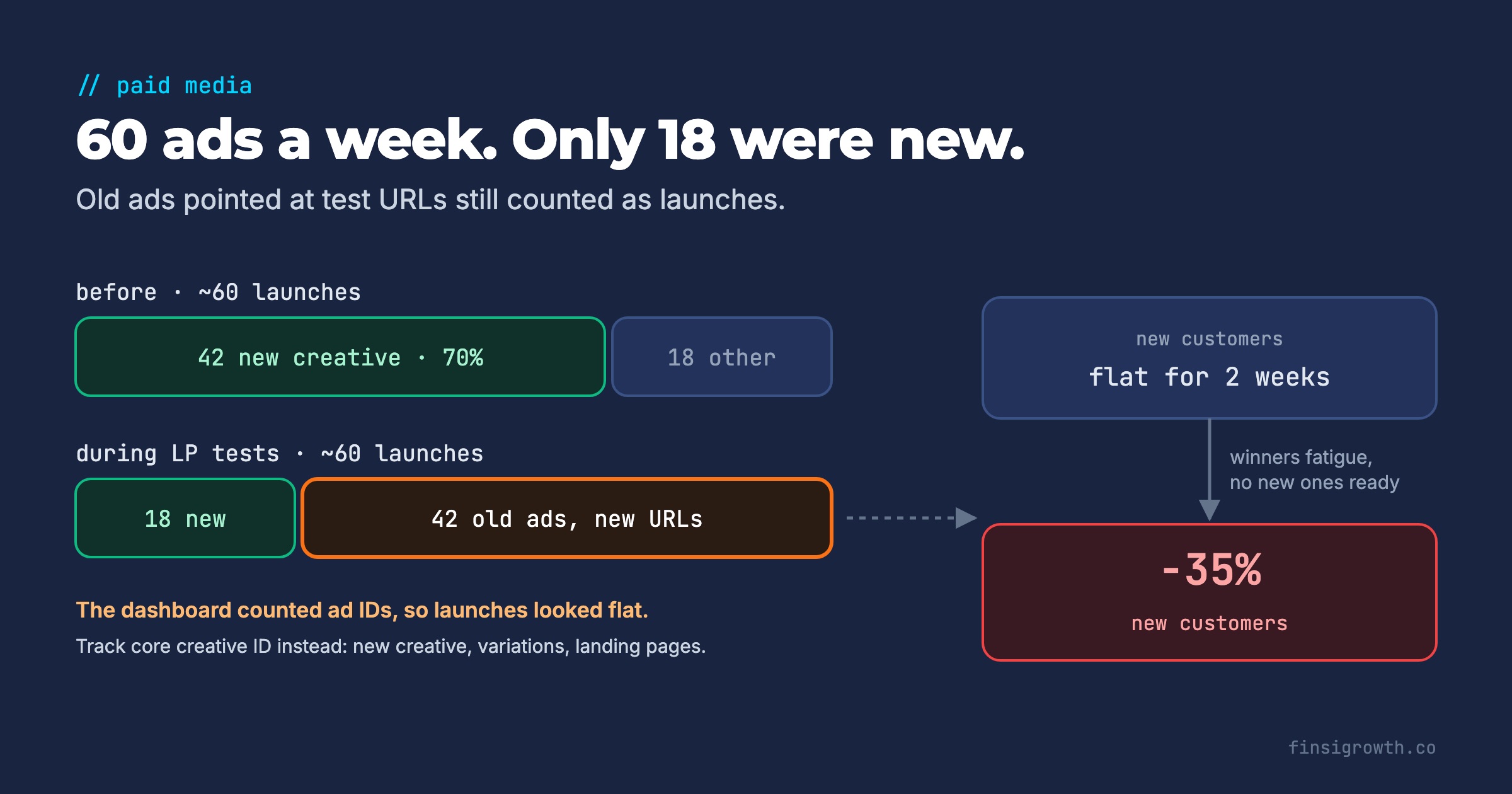
An account launches around 60 ads a week. The dashboard says creative output is healthy. Six weeks later, new-customer acquisition is down 35% and nobody can say why.
That’s what happened to one DTC brand. It had started a round of landing page tests. To run them, the team reused winning ads and pointed them at new URLs. Each one counted as a “new ad launched.” Real new creative quietly fell from about 70% of launches to 30%.
This guide covers why that happens, why the damage shows up weeks late, and how to track your launch mix so a landing page project can’t hollow out your creative pipeline again.
Key Takeaways
- A reused ad pointed at a new URL is a new ad object, and most dashboards count it as a new launch. Launch volume can stay flat while new creative collapses.
- In this account, new creative fell from ~70% to ~30% of launches. New customers held flat for two weeks, then fell 35%. The lag hid the cause.
- Track launches by core creative ID, not ad name, and sort every launch into three buckets: new creative, small variations and new landing pages.
- Plot the launch mix next to weekly new customers, frequency, CPC and CPA so you see the input drop before the output does.
- Run landing page tests on their own budget, one variable at a time, ideally with a post-click split on one URL so they don’t take launch slots from creative.
What actually happened in this account?
The brand kept its launch count steady while replacing most of its new creative with recycled ads. Because the dashboard counted ad IDs, the swap was invisible. Here’s the sequence:
- The brand started landing page tests that ran for about a week at a time.
- To drive traffic, the team took existing winning ads and pointed them at new URLs.
- Each of those became a new ad, with a new ad ID.
- The reporting dashboard counted every new ad ID as a “new ad launched.” Weekly launches stayed around 60.
- Underneath, new creative dropped from about 70% of launches to about 30%.
- New customers stayed flat for two weeks after the drop started. By the time the decline was obvious, the problem was six weeks old.
- New-customer acquisition ended up down 35%.
The chart below models that pattern. Total launches never move. The mix inside them does, and new customers follow a few weeks behind.
Why does a landing page test count as a new ad?
Because in Meta, the destination URL belongs to the ad. Pointing an existing creative at a new page means building a new ad (by duplicating or rebuilding it), and every ad has its own ID. Most launch trackers count ad IDs or ad names, so a recycled creative with a new URL looks exactly like a fresh concept.
That’s a reporting problem, not a Meta problem. A few side effects are worth knowing, though:
- Social proof can reset. A duplicated ad starts with its own engagement unless you carry it over. Meta’s duplication flow has an option to show existing reactions, comments and shares on the new ad (Meta Business Help Center, Duplicating ad campaigns). Using an existing post ID does the same job (Meta, Ads from existing posts).
- Learning can restart. Meta’s API states plainly that “significant edits cause ad sets to reenter the learning phase” (Meta Marketing API, Ad Campaign Learning Stage Info). Meta doesn’t publish whether a URL swap alone counts. Expect that adding new ads to a live ad set can shake delivery, and plan around it.
- Naming hides it. Many teams track launches by ad name, then change the ad name to reflect the landing page. The name changes, the creative doesn’t, and the tracker counts a launch.
The decision: stop treating “ads launched” as a measure of creative output. It measures ad objects, and ad objects are cheap to make.
Why did new customers take weeks to drop?
Because your current winners keep carrying the account until they fatigue. New creative is what replaces them, so cutting it doesn’t hurt this week. It hurts when this month’s winners wear out and nothing new is ready to take their place.
Three things make that lag dangerous:
Winners are rare, so volume matters. Motion’s 2026 benchmarks cover over 550,000 ads from more than 6,000 advertisers and about $1.3 billion in Meta spend. Only 5–8% of ads became real winners, and about half never got meaningful spend (Motion, 2026 Creative Benchmarks). Apply that to this account. At 42 new concepts a week, you’d expect roughly 2–3 future winners. At 18, you’d expect about one. That shortfall compounds every week the mix stays broken.
Meta’s delivery system rewards variety. Meta’s Andromeda retrieval engine was built “to scale up to a large volume of ads creatives,” and Meta’s engineers say increased ad diversity can “drive better advertiser outcomes” (Engineering at Meta, Dec 2024). In September 2026, a Meta spokesperson called creative diversification a “longstanding best practice” (Marketing Brew, Sep 28, 2026). A recycled ad with a new URL adds no new variety for the system to find new people with. We covered the account-level side of this in our Andromeda rebuild guide.
Creative is the biggest lever you control. An NCSolutions meta-study of nearly 450 CPG campaigns found creative drove 49% of incremental sales, ahead of brand, reach, targeting and recency (NCSolutions via PR Newswire, Aug 2023). That’s CPG on TV and digital, not DTC on Meta. The direction still holds: cut creative and you’ve cut the input that matters most.
New creative is a leading indicator. New customers are a lagging one. If you only watch the lagging one, you’ll find out six weeks late.
Why do landing page projects crowd out creative?
Because both draw from the same two limited pools: your team’s attention and your test budget.
People get pulled across. The same marketers usually brief creative and build landing pages. A new “landing page initiative” is exciting and visible. Creative briefs slip quietly, and nothing in the launch count flags it.
Test budget is finite. Every dollar spent proving a landing page is a dollar not spent finding the next winning ad. You can’t test lots of creative and lots of landing pages well at the same time on a fixed budget.
And landing page tests mostly don’t win. At Google and Bing, only about 10–20% of experiments produce positive results; at Microsoft overall, a third are positive, a third neutral and a third negative (Kohavi & Thomke, Harvard Business Review, Sep–Oct 2017). Optimizely’s review of 173,000 experiments found well-designed tests win 58% of the time versus 35% for poorly designed ones (Optimizely, 2026). Either way, a landing page sprint is a set of bets. It shouldn’t be funded by quietly stopping new creative.
The decision: give landing page tests their own people-hours and their own budget line, with a clear end date.
How do you track launches so this can’t hide?
Track every launch by its core creative ID and tag it into one of three buckets. Then count new creative separately from everything else.
Use a core ID in every ad name
Give each creative concept a permanent ID the moment it’s briefed. Every ad that uses that concept carries the same core ID, whatever its URL, variation or audience. A simple pattern:
| Part | Example | What it tells you |
|---|---|---|
| Core creative ID | C0412 | The concept. Never changes. |
| Bucket | NEW / VAR / LP | Why this ad exists |
| Variation | V03 | Hook, cut or copy change |
| Landing page | LP-quiz | Where it sends traffic |
So C0412_LP_V01_LP-quiz is an old concept pointed at a new page. It’s a launch, but it isn’t new creative, and your tracker should never count it as such. Track by core name, not ad name.
Sort every launch into three buckets
- New creative: a core ID that has never run before. A new concept, angle, format or person on camera.
- Small variations: an existing core ID with a new hook, edit, headline or aspect ratio.
- New landing pages: an existing core ID pointed at a new URL.
Only bucket 1 counts toward your creative pipeline. Buckets 2 and 3 are useful, but they’re optimization, not new supply.
Plot the inputs and outputs together
Each week, chart these on one page:
- Launches per bucket, stacked, plus new-creative share (bucket 1 ÷ all launches)
- New customers per week, from your store’s first-time orders, not platform-attributed purchases
- Frequency, to see existing ads wearing out
- CPC and CPA, to see the cost of that fatigue
The point is to see the input drop before the output does. In the chart above, the creative share broke in week 3. New customers didn’t move until week 5 or 6. With both on the same page, you’d have caught it in week 3.
Set an alert on new-creative share. Pick a floor that matches your normal mix (if you usually run 60–70% new creative, 50% is a sensible tripwire) and review it any week it breaks. Pair it with a weekly check on blended CAC and MER, so you judge the account on new customers and total spend, not attributed ROAS.
How should you run landing page tests instead?
Run them so they don’t consume creative launch slots or creative budget. Four rules cover most of it.
- Split traffic after the click when you can. A post-click A/B tool on your site can split one ad URL across two page versions. The ads don’t change, no new ad IDs appear and your launch count stays honest. It also keeps ad-side variables identical across both versions.
- If you test inside Meta, isolate it. Meta’s guidance is to “test only one variable at a time,” run tests “for at least 2 weeks or up to 30 days,” and not reuse the test audience in other campaigns running at the same time (Meta for Business, A/B testing). Use a dedicated campaign or Meta’s A/B testing tool, not your main scaling ad sets.
- Fund it from a separate line. Decide upfront what share of spend goes to landing page tests and keep creative testing budget untouched. If the landing page budget needs to grow, it comes out of scaling spend, not new creative.
- Keep creative briefs on schedule. Before a landing page project starts, lock the weekly number of new concepts it must not reduce. Then check it in the same weekly review as the launch mix.
When a landing page wins, roll it out across your proven ads by changing the URL in one planned batch, and tag those ads LP so they never inflate your new-creative count.
What should you do this week?
Pull the last eight weeks of launches and re-tag them by core creative ID into the three buckets. If your new-creative share fell while total launches held steady, you’ve found the problem before your new-customer numbers did.
For the kill-or-scale decisions on the creative you do launch, use our CPA-vs-spend map. For the account-level view of when to push or pull total spend, see the e-commerce scaling scorecard.
If you’d rather have launch-mix tracking, new-customer reporting and creative testing run for you every week, that’s part of what Finsi Growth does for DTC brands.
Frequently Asked Questions
Does pointing an existing ad at a new landing page reset the learning phase?
It can. Meta says significant edits send an ad set back into learning, but it doesn’t publish whether a URL change alone counts. Pointing a reused creative at a new URL usually means adding a new ad, which can disturb delivery in a live ad set. Test landing pages in a separate campaign or split traffic after the click.
How many new creatives should a DTC brand launch per week?
There’s no universal number; it depends on spend and how fast your ads fatigue. What matters more is the share. If new creative is normally 60–70% of launches, treat a sustained drop below about half as a warning sign, whatever the total launch count says.
What counts as “new creative” versus a variation?
New creative is a concept that has never run before: a new angle, story, format or person on camera. A variation keeps the concept and changes a hook, edit, headline or aspect ratio. A new landing page keeps the concept and changes only the destination.
Which metric shows the damage first?
New-creative share shows it first, because it’s the input. Frequency and CPA usually rise next as existing ads fatigue. New customers per week move last. Watching all of them on one chart is what turns a six-week surprise into a one-week fix.