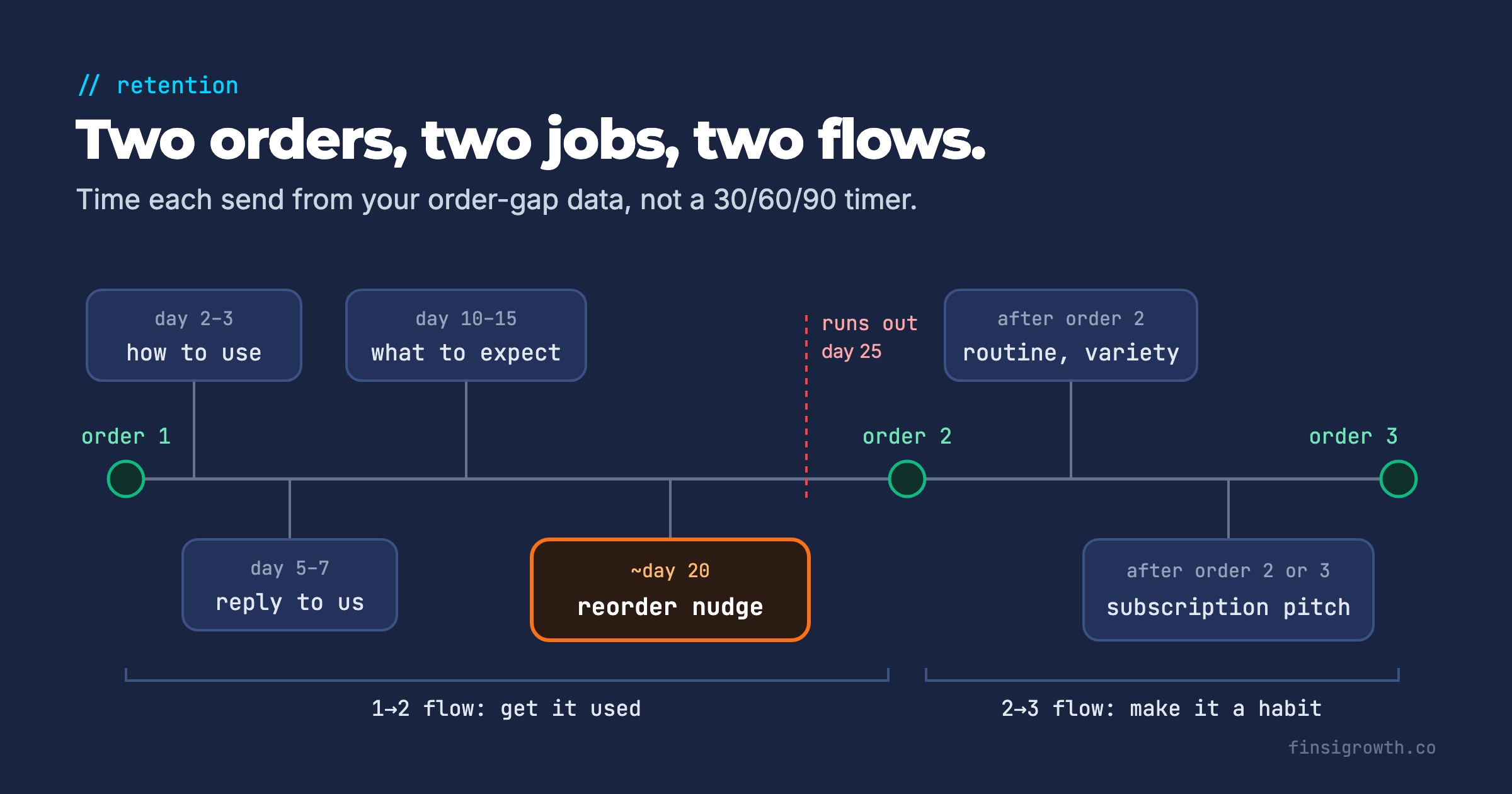
Most brands run one post-purchase flow. It starts at checkout, sends a thank-you, a review request and a discount, and then goes quiet after two or three weeks. That flow is trying to do two different jobs, and it usually does neither.
The second order and the third order fail for different reasons, at different times. So build two flows: a 1→2 flow that gets the product used and reordered, and a 2→3 flow that turns a repeat buyer into a habit. Time both from your own order-gap data, keep discounts out of them, and hold the subscription pitch until the customer has bought at least twice.
Key Takeaways
- In February we argued that the third order is the real conversion event. This post is the build: one flow per step, timed from when your customers actually reorder.
- Pull the gap between order 1 and order 2 for every repeat customer. Split subscribers from one-time buyers, because their curves look nothing alike.
- Send the reorder nudge a few days before the product runs out, not on a generic 30-, 60- or 90-day timer.
- Lead with education and expectations. “Silence leads to cancellations,” and steep discounts select customers who leave.
- Pitch subscription after the second or third purchase of the same item, not on day one. Offer prepaid plans only to customers with months of tenure.
Why one post-purchase flow isn’t enough
Because a first-time buyer and a second-time buyer have different questions. After order 1, the customer is asking “does this work, and am I using it right?” After order 2, the product has passed that test. Now the question is whether it fits a routine, at the right quantity and cadence.
We hear the same gaps on call after call. A health-testing subscription told us in April: “after two or three weeks, we don’t email anybody.” A dog-supplement brand’s flows only covered the first 30 days, so we added 30–60 and 60–90 day flows. A large coffee roaster’s replenishment flows ran on static 60- and 90-day timers with “no intelligence.” A beauty brand told us that a customer with no purchase in 90+ days has probably churned for good. The welcome series has to do its work in the first 60.
Underneath all of these sits one fact: the first-to-second order step is the biggest drop. Brand after brand described it as the cliff, from a dog-supplement brand to an edibles brand that called the second-purchase rate its “critical focus” for July.
Step 1: Pull your order-gap curve
The order-gap curve is a histogram of days between first and second orders, for customers who reordered. It’s the single most useful input for flow timing, and you can build it from a Shopify export in an hour.
- Export orders with customer ID, order date, product and whether the order came from a subscription.
- For each repeat customer, calculate days from order 1 to order 2. Then do the same for order 2 to order 3.
- Plot the counts by day, out to 120 days. Note the median and the 25th and 75th percentiles.
- Split subscribers from one-time buyers. If you only do one thing on this list, do this.
The split matters because subscriptions create artificial spikes. A frozen-food brand we work with showed us the curve in June. Subscriber reorders spiked at 28, 42 and 56 days, exactly the 4-, 6- and 8-week plan intervals. One-time buyers reordered in a smooth spread out to about 40 days, then dropped off. A tea brand saw the same thing: repurchase spikes at its selling-plan intervals of 30, 45, 60 and 90 days.
Blend those together and the timing is wrong for both groups. In one brand’s data, the median time to a second order was about 28 days with subscribers included and about 15 days without them. A flow timed to 28 days would reach one-time buyers two weeks after most of them had already decided.
The curve also shows when customers leave, not just when they buy. The frozen-food brand’s cancellations didn’t spike at the charge. They spiked around day 36, when the second box arrived and people remembered they had subscribed. A wine club’s cancels clustered on days 11 to 14, right after delivery. Both are communication problems you can only see on a timeline.
Step 2: Set send times from the curve, not a template
Two rules cover most cases.
Education goes in before the first moment of doubt. That’s usually in the first two weeks, before the customer has decided whether the product works. The frozen-food brand’s plan was simple: communicate in the first two weeks, go quiet while they eat the product, then re-engage between days 30 and 40.
The reorder nudge goes a few days before the product runs out. Calculate the run-out date from pack size and use, not from your average. The tea brand worked through an example in June: 50 sachets at two cups a day runs out around day 25, so the reminder goes around day 20. A different pack size gets a different branch. The same brand used to default subscriptions to 90 days. Its new product-page calculator recommends a frequency from serving size and consumption.
Small timing errors cost real conversions. A personal-care brand found that 30% of its non-subscriber buyers converted to subscription around day 25. Its subscription email went out on day 20. The founder’s request was exactly right: overlay every flow on the actual lifecycle timeline.
Defaults matter too. When the tea brand’s subscription platform changed its default reminder from 15 days to 30, cohort behaviour visibly shifted. Its replenishment emails were also sitting in manual or draft status and had never sent. We recommended a hard-coded day 30–45 trigger for that catalog. Check that your flows are live before you redesign them; we covered silent Klaviyo flow failures in April.
If you use Klaviyo, its predictive analytics add an expected date of next order and an average time between orders to each profile. They need at least 500 customers with orders, 180 days of history, recent orders and some customers with three or more orders (Klaviyo Help Center, updated August 2025). Klaviyo itself warns against flows that simply count down to the expected date, because repeat customers can get the same emails before every order. Use the prediction to check your timing, and build the flow logic on order number and product.
Step 3: Build the 1→2 flow around use, not offers
The 1→2 flow has one job: get the product used well enough that the customer reorders at full price. Here’s a template we adapt per brand. The days shift with your curve; the purpose of each send doesn’t.
| Send | Timing (adjust to your curve) | Content | Goal |
|---|---|---|---|
| 1 | Day 2–3 | How to use it, what to expect first | First use goes right |
| 2 | Day 5–7 | ”Reply to us”: questions, problems, first impressions | Surface problems before they become cancels |
| 3 | Day 10–15 | Expectation timeline: what changes when | Stop “it didn’t work” churn |
| 4 | 3–5 days before run-out | Reorder reminder, matched to pack size | Second order at full price |
| 5 | 1–2 weeks after run-out, no order | Second reminder or routine prompt | Catch late reorderers |
| Exit | Order 2 placed | Move to the 2→3 flow | — |
The reply-to-us email does more than it looks. For a supplement brand’s post-purchase plan in June, its sends ran on days 3, 5, 7, 15, 30 and 90. We added “reply to us” emails at days 7 and 25 and a “where to look” message. Some customers won’t notice an effect until around day 45, so they need to know what to watch for. In that founder’s words: “Silence leads to cancellations.” The dog-supplement brand planned a timeline card for the same reason: more energy at two weeks, coat changes at four to six.
Then there’s the starter purchase itself. First purchase and repeat purchase are different behaviours, so reduce thinking the first time. For a food brand we recommended a predefined starter box over a build-your-own selector. The second order is where choice and variety start to help.
Step 4: Build the 2→3 flow around routine and variety
A second-time buyer has already said yes to the product. The 2→3 flow makes it part of their routine, and it can be more personal because you now know what they buy.
- Personalise by what they bought. A book-and-drink subscription box planned its 2× buyer email for day 12, personalised by drink type: tea, coffee or cocoa. Its first-time buyers got a content email on day 3 and a subscription email on day 18.
- Cross-sell once they’ve tried the product. The same box planned merchandise cross-sells between days 15 and 30, not at checkout.
- Rotate flavours before fatigue sets in. The tea brand saw customers buy a flavour five times and then go off it. Cross-sell a neighbour before that happens.
- Give three-time buyers status, not discounts. The box gave 3× buyers early access as a “special cohort.”
That box tracked one number for the whole programme: 57% of its buyers had three or more orders, and the target was 70%. That’s the right kind of goal. It measures the step, not the email.
Why keep discounts out of both flows?
Because discounts in these flows teach the customer to wait, and they select the wrong customers in the first place.
The evidence in our calls is consistent. A tea brand found a cohort of yearly buyers who wait for the discount email; one customer said so directly. A dog-supplement brand acquired with 30–40% off, and its top cancel reason was money. We proposed testing 33% against 20% and judging on cancel speed and LTV-to-CAC ratio, not conversion rate. An edibles brand cut its subscribe discount from 40% to 25% and is tracking zero-day cancels. We went into the cohort side of this in discount depth and cohort quality.
What works instead is extra value. A book box told us in June that “our customers don’t really respond to discounts.” For brands like that, we push buy-one-get-one or a gift with purchase over a percentage off. People value extra product more than a lower price. Other no-discount levers: usage guides, a free-shipping threshold bundle and a limited release. Where you’re weaning a list off discounts, keep emailing but drop the codes one send at a time.
When should you pitch subscription?
After the second or third purchase of the same item. Not on day one, and not in the first email after checkout.
- A nutrition brand with an average of 1.5 orders per customer decided to pitch subscription after the second purchase of the same item.
- Several brands, including a vinyl club, told us many customers make two to five purchases before they subscribe.
- A juice brand’s Amazon experience was that it takes “a couple purchases” before someone converts to subscription. Its plan: repeat purchase first, subscription after three or more.
- The tea brand sends its subscribe nudge after three or more one-time orders, and has tested sending it at 75 against 120 days.
There’s a good reason for the wait. By order 3 you know the customer’s real cadence, so the subscription can match it. Get the cadence wrong and subscribers pile up product, which is the classic “too much product” cancel. An edibles brand now offers a different cadence to anyone who skips two or more orders.
Longer commitments need even more patience. The tea brand offers a 6-month prepaid plan only as an upsell to subscribers with three or more months of tenure, never on the product page. The vinyl club’s prepaid upsell pop-up broke and was switched off, leaving month-to-month only. New-member conversion then “shot through the roof.” Client results are specific outcomes, not typical or guaranteed. But the pattern is clear: commitment asks work better once the habit exists.
How to measure whether the flows work
Measure the step, not the email. For each flow, track:
| Flow | Primary metric | Window | Guardrail |
|---|---|---|---|
| 1→2 | Share of first-time buyers placing order 2 | Your 75th-percentile gap from Step 1 | Unsubscribes and discount share of order 2 |
| 2→3 | Share of 2× buyers placing order 3 | Same, measured from order 2 | Average discount on order 3 |
| Subscription pitch | Share of 2–3× buyers who subscribe | 60 days after the pitch | Cancels within the first two renewals |
Hold out 10% of each flow’s entrants so you can see the lift against customers who got nothing. Email attribution windows will flatter any flow that sends often, so judge it on reorder rate against the holdout, not on attributed revenue. Check contribution margin per reorder too. A flow that lifts order 2 with a 25% code may still lose money.
What to do this week
- Export orders and build the gap curve for order 1→2 and 2→3, split by subscriber and one-time buyer. Note the median and the 75th percentile.
- List every live post-purchase send with its day. Mark which ones fall after most of your customers have already reordered or left.
- Calculate run-out dates for your top three products by pack size. Move the reorder nudge to 3–5 days before each one.
- Add one reply-to-us email around day 7 of the 1→2 flow. Read every reply for two weeks.
- Pull the discount out of one send and replace it with a usage guide or a gift with purchase. Run it against a 10% holdout.
- Move the subscription pitch from the first post-purchase email to after the second purchase of the same item.
Market for three orders, not one
Your acquisition team buys the first order. Your flows decide whether there’s a second and a third. Time them from your own data, teach before you sell, and save the subscription ask for customers who’ve already shown you their routine.