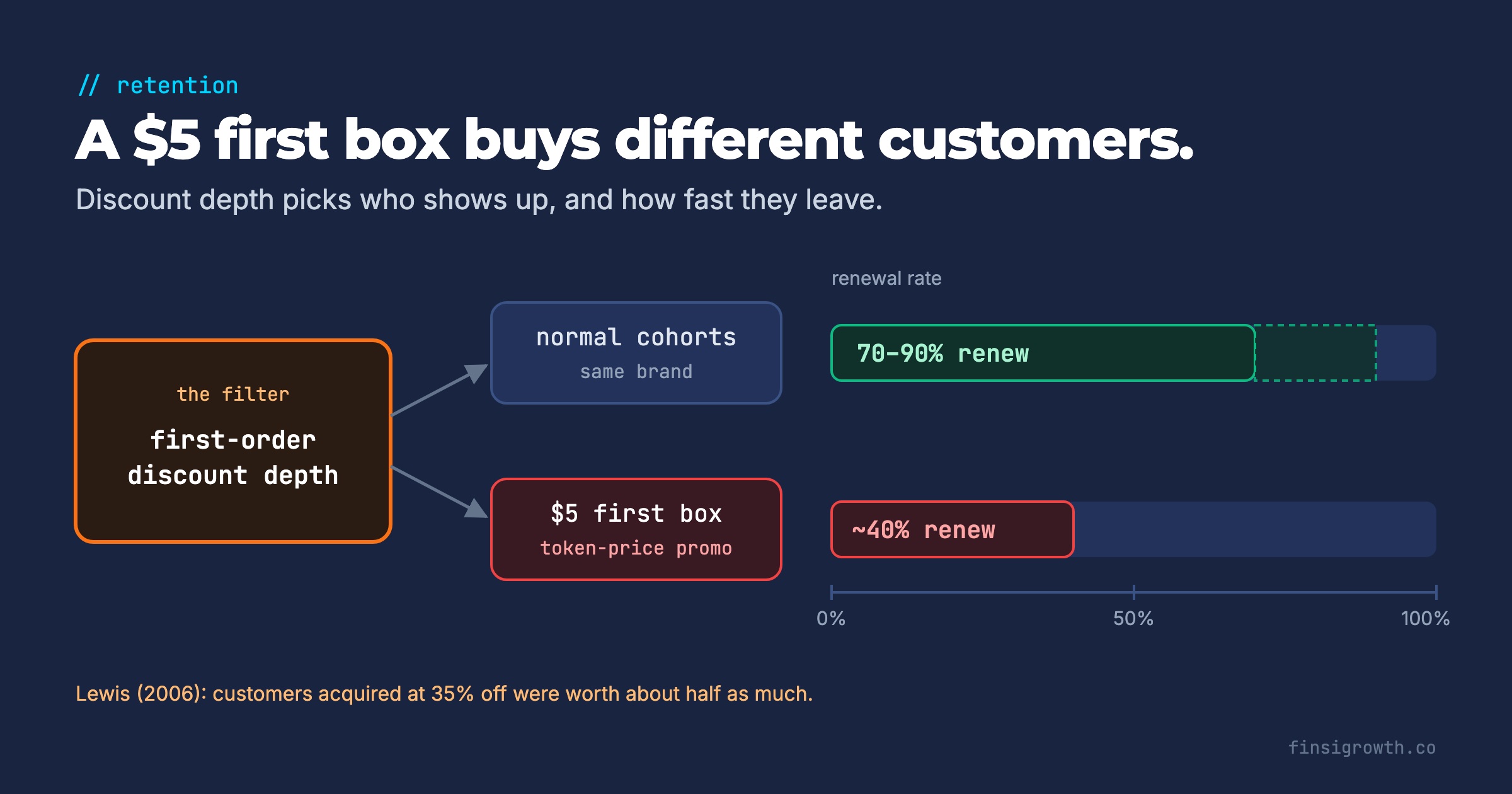
A deep intro discount doesn’t just lower the price of the first order. It changes who shows up. The deeper the offer, the more of your new cohort is there for the deal, and the faster that cohort leaves once full price arrives.
We see it across the subscription brands we work with. At one dog subscription box, a $5 first-box promo brought in a cohort that renewed at about 40%. Its normal cohorts renew at 70–90%. The promo didn’t buy cheap subscribers. It bought a different kind of customer.
Key Takeaways
- Discount depth is a cohort-selection decision, not just a pricing one. In our client data, a $5 first-box cohort renewed at ~40% against 70–90% for normal cohorts.
- Academic data agrees. In Lewis (2006), customers acquired with a 35% discount were worth about half as much as customers acquired without one.
- Bargain hunters show themselves fast: auto-renew switched off within minutes of signup, cancels at the first full-price charge, and re-subscribes on the next offer.
- The cliff often isn’t the discount itself but the step-down. At one supplement brand, a 30% first-order discount dropping to 5% on renewals was the main churn driver.
- Tag every first order by discount depth, then compare renewal, time-to-cancel and margin-based LTV by bucket before you plan the next promo.
Why does discount depth change who buys?
Because a discount is a filter. A full-price offer only converts people who already want the product. A $5 offer also converts people who want a deal, are curious, or plan to cancel before the second charge. Those people aren’t doing anything wrong. They’re responding to the offer you made.
Michael Lewis studied this with customer-level data from a newspaper and an online grocer. In both, deeper acquisition discounts went with lower repeat-purchase rates and lower customer asset value. His example: a 35% acquisition discount produced customers worth about one-half the long-term value of those acquired at full price (Journal of Marketing Research, May 2006).
Free trials, the deepest discount there is, show the same pattern. A study of 16,512 households at a European digital TV provider found free-trial customers stayed only one-third as long as regular customers. Their profit was about 59% lower (Phys.org summary of Datta, Foubert and Van Heerde, Journal of Marketing Research, April 2015).
The same study found a useful nuance. Free-trial customers responded more to marketing after the trial. A discounted cohort isn’t a lost cause, but it needs its own plan.
What does a bargain-hunter cohort look like in the data?
From our client and discovery calls between mid-2025 and January 2026, the pattern has four recognizable signatures.
1. Lower renewal at the first full-price charge. The dog box’s $5 cohort renewed at about 40%, against 70–90% for normal cohorts. That same year, promos brought in 2–3× more customers than the year before. Month-3 retention fell from about 80% to about 60%. Volume tripled while quality slid, and topline growth hid it.
2. Cancel-within-minutes behavior. Some of those $5 subscribers turned off auto-renew minutes after signing up. A dashboard metric showing “average lifespan 6.3 days” turned out to be time-to-cancel-auto-renew, not real customer lifespan. The box shipped, the customer was already gone.
3. Discount cycling. A home-device brand with a consumables subscription cut a roughly $1,000 purchase to about $950 for subscribers. Many cancelled two to three weeks later. Then they came back 10–12 months later for a $20 refill discount and cancelled again. The founder called it impossible to forecast.
4. Duplicate and re-subscribes. Two subscription boxes we work with found customers re-subscribing on each new offer while still active. The result was double shipments, double support tickets and an inflated subscriber count.
A $10M+ home-fragrance brand put it bluntly on a call in November: subscribers treated the program as “just a discount.” Its churn rose across every subscription channel it sold through, Amazon included.
Client results are specific outcomes, not typical or guaranteed.
Is the depth the problem, or the step-down?
Often it’s the step-down. A wellness-supplement brand with more than 80% of revenue on subscription talked to us in December. Its main churn driver was the drop from a 30% first-order discount to 5% on recurring orders. Customers didn’t leave because the price was high. They left because it rose by about a third overnight.
The dog box customer said the same thing in fewer words: they paid $5 for the first box and then faced a full-price charge. The perceived price change is what triggers the cancel, not the absolute price.
That gives you two levers, not one:
- Depth: how far below full price the first order sits.
- Gap: how big the jump is between order one and order two.
A 20% discount that holds for three orders can produce a better cohort than a 50% discount that vanishes on order two. Test both before assuming a cheaper first order is the problem.
Does a deeper discount at least improve retention by locking people in?
Not in the data we’ve seen. A nutrition subscription brand with about 10,000 subscribers was considering raising its subscribe discount from the 8–15% range to 25%. Its month-1 reorder rate had dropped to about 20% from roughly 50%. Our read on that call: a bigger discount moves conversion, not month-2 retention.
Depth isn’t the only variable. The same dog box ran a $9 December first-box offer whose cohort renewed at 93.8%. That’s still a deep discount. What changed was who the offer reached and why. Treat any single depth number as a hypothesis about your audience, not a rule.
How do you measure discount depth by cohort?
You need one extra field on every first order: the discount depth. Shopify stores the discount code and amount on each order, so you can derive it without new tooling.
| Depth bucket | How to define it | What to compare |
|---|---|---|
| Full price | No code on first order | Your baseline for every metric below |
| Light (1–15%) | Welcome code, small subscribe discount | Renewal rate at order 2 and order 3 |
| Mid (16–30%) | Seasonal promo, stacked codes | Time to cancel or auto-renew off |
| Deep (31%+) | BFCM, affiliate, influencer offers | Margin-based LTV at 90 and 180 days |
| Token price ($1–$10 box) | Fixed-price first order or free trial | Payback on CAC, share cancelling within 24 hours |
Then build these four views:
- Renewal by depth bucket. Share of each bucket that pays for order 2 and order 3 at full price. This is your core cohort analysis cut.
- Time-to-cancel distribution. Minutes, days or weeks from signup to cancel or auto-renew off. A spike in the first 24 hours is the bargain-hunter signature.
- Margin-based LTV. Use contribution margin, not revenue. The discount itself is a cost, so a deep-discount cohort starts in a hole.
- Payback period by bucket. How many full-price orders each bucket needs to recover its CAC plus the first-order discount.
One warning on definitions. Some billing platforms count auto-renew off as churn, even when the customer keeps receiving a prepaid plan. One client saw “50% churn” in a report for exactly this reason. Agree on what counts as churned before you compare buckets, or the deep-discount bucket will look worse or better than it is.
What should you do with a bargain-hunter cohort?
Don’t treat it like your best customers, and don’t write it off either. Three moves have worked on calls we’ve sat in on.
Give it its own flows. A discounted cohort needs a reason to stay that isn’t price. Send product education and first-use guidance before the first full-price charge, not after it.
Don’t win back deal-only churners at the same depth. A large meal-delivery subscription drops affiliate churners who came in on 50% off from its win-back audience. Re-acquiring them at the same discount restarts the cycle.
Watch what the promo teaches your ad account. A gift-heavy subscription brand saw Meta CAC jump from $7 to $23 overnight. A promo code had expired while the ads kept running. The founder’s theory was that the account had been trained on coupon chasers. Whatever the cause, plan the post-promo handoff before the promo launches. We covered why January is a good time to rethink this in January isn’t dead.
A functional-drink brand takes a different route. It tests gift offers instead of price cuts partly to screen out what its team called “discount, freebie people” who unsubscribe right away.
Client results are specific outcomes, not typical or guaranteed.
How do you decide the right depth?
Work backwards from payback, not from conversion rate. The question isn’t “which offer converts best?” It’s “which offer produces customers who repay their CAC and discount fastest?”
Here’s the math with illustrative numbers. Say your box costs $40 at full price, with $16 of contribution margin per full-price box and a $45 CAC.
- Full-price customer: needs about three boxes to pay back $45 CAC.
- $5 first-box customer: the first box loses money, so the customer needs about four full-price boxes to pay back.
- If the $5 cohort renews at 40% and the full-price cohort at 80%, far fewer $5 customers ever reach box four.
Run your own numbers with real renewal rates from the depth-bucket report. Often the deep offer looks great at the top of the funnel and terrible at payback. Sometimes it’s fine, like that $9 December cohort. Only your data can tell you which.
If you’re still pulling these numbers from several dashboards that disagree, start with reconciling platform revenue to Shopify. Then pick the two metrics that matter, as we argued in two priorities, not twenty dashboards.
What to do this week
- Export first orders for the last 12 months with discount code, discount amount and subtotal. Calculate depth as discount ÷ subtotal.
- Assign each customer a depth bucket using the table above. Add a sixth bucket for affiliate or influencer codes if they’re material.
- Pull renewal at order 2 and order 3 for each bucket. Only include cohorts old enough to have reached those orders.
- Chart time-to-cancel for each bucket. Flag what share cancelled or switched off auto-renew within 24 hours.
- Calculate margin-based payback per bucket. Include the first-order discount as a cost.
- Write down the depth and gap for your next promo before you launch it. Decide which bucket you’re willing to buy, and at what renewal rate you’d stop.
Common questions
Is it ever right to run a deep intro discount?
Yes, when the cohort still pays back. That $9 December offer renewed at 93.8%. If a deep offer’s bucket clears your payback target on real renewal data, keep it. If not, the volume is costing you money.
Should I count auto-renew off as churn?
Track it separately. It’s an early signal of intent to leave, but prepaid customers who switch it off may still be active. Report both, and use the same definition across every depth bucket.
Price is a filter
Every discount picks your next cohort for you. Pick it on purpose. Measure renewal and payback by discount depth, and let that number decide your next promo, not last quarter’s conversion rate.