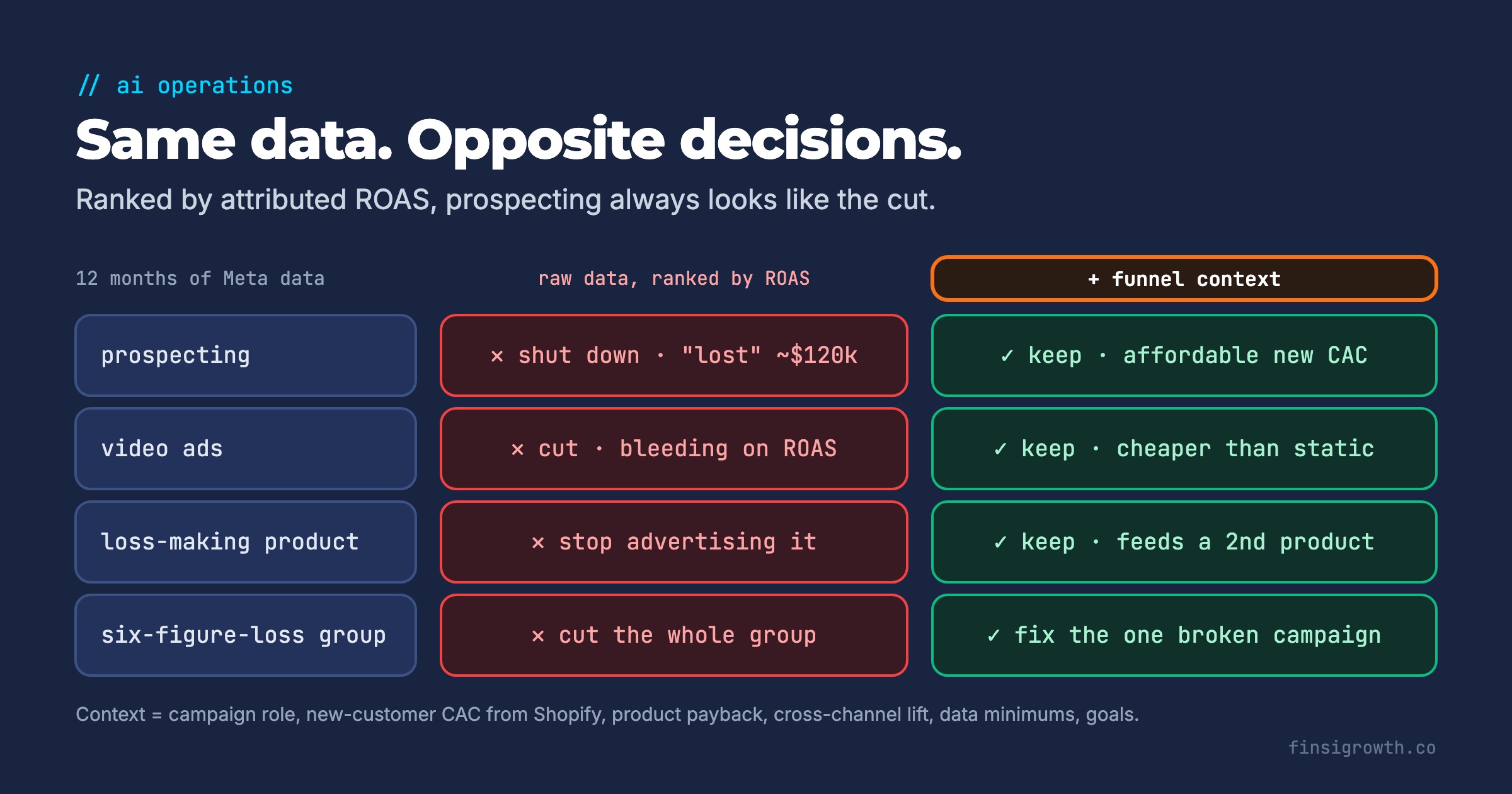
Give a general-purpose AI twelve months of Meta data and ask where you’re wasting money. The answer is almost always the same: cut prospecting, cut creative testing, cut video, and move the budget to retargeting, branded search or Google. It sounds rigorous. It’s usually wrong.
The AI isn’t broken. It’s ranking campaigns by attributed ROAS, and attributed ROAS rewards the campaigns that close demand, not the ones that create it. Without funnel context (which campaign does which job, what a new customer costs and what that customer is worth later), the cheapest-looking campaigns win every time. Those are the ones harvesting buyers your prospecting already found.
Key Takeaways
- Generic AI ad analysis ranks by attributed ROAS. Prospecting, testing and video always look worst on that metric, so they’re always the first cut.
- Retargeting and branded search mostly collect demand created elsewhere. An eBay field experiment found brand-keyword ads had no measurable short-term benefit.
- Judge prospecting on new-customer CAC from Shopify and on payback, not on in-platform ROAS.
- An AI needs six pieces of context: campaign role, new-customer CAC, product-level payback, cross-channel lift, minimum data thresholds and your goals.
- Before cutting a prospecting campaign, test the cut. Watch new customers, branded search and blended numbers for at least 7 days.
What does generic AI ad analysis actually recommend?
It recommends shutting down whatever has the worst attributed return. We see the same handful of recommendations across brands, and operators keep describing them to us.
The clearest example came from our own side-by-side test this spring. We ran one client’s last 12 months of Meta data through a general-purpose AI with no added context. Then we ran it through our analysis setup, which adds campaign roles, new-customer CAC and retention data.
| Finding | Generic AI with raw data | Same data with funnel context |
|---|---|---|
| Main prospecting campaign | ”Lost you” roughly $120k. Shut it down. | Expensive but functional. Still acquires new customers at a cost the business can afford. |
| Video ads | Bleeding money on ROAS. Cut. | Acquires customers cheaper than static. Keep. |
| A product with negative returns | Losing money. Stop advertising it. | A strong acquisition product. Buyers are retargeted into a second product that sells well. |
| A group of campaigns with six-figure losses | Cut the group | Only one is truly broken on new-customer CAC. The rest are doing prospecting work. |
Same data, opposite decisions. The generic version would have cut most of the account’s new-customer acquisition.
Operators report the same pattern in their own tools. A VP of marketing at a large baked-goods brand told us in March that AI budget recommendations were “70% of the time wrong.” The tools told him to kill his top-spending ad. One moved $640 a week onto an ad with $100 of spend and 4 conversions. Another tool told a friend of his to move top-of-funnel budget to bottom-of-funnel. His summary: these tools “read a handful of blog posts on marketing.”
Across May calls, the two recommendations we heard about most were the same pair. Kill creative testing and top-of-funnel, because they show the worst ROAS. And move budget to Google, because Google’s own reporting looks best. One founder estimated AI ad assistants are “90% wrong.” That’s an estimate, not a measurement, but it matches what we see.
Why does prospecting always look worst?
Because attribution credits the last campaign a buyer touched, and prospecting is rarely last. Here’s the mechanism in four steps.
- A prospecting ad reaches someone who has never heard of you. They watch, maybe click, and leave.
- Days later they see a retargeting ad, open an email or search your brand name on Google.
- They buy. The retargeting ad, the email or the branded search click gets the credit.
- The prospecting campaign shows spend and few purchases. An AI ranking by ROAS calls it the worst performer.
Branded search is the extreme case. A large field experiment at eBay found that “brand-keyword ads have no measurable short-term benefits.” People searching the brand name were coming anyway (Blake, Nosko and Tadelis, NBER Working Paper 20171, May 2014). Branded search can still protect your name from competitors. But its high ROAS is mostly a receipt for demand that already existed.
We see this in client accounts all the time. On a December call with a frozen-food brand, we described Meta and Google as a “sweet couple”: Google brand search kept claiming demand that Meta created. Our standing advice is that Google spends against existing demand. So raise it on email and launch days, when demand spikes. And treat a sudden Google or Performance Max spike as a sign that something else, like an influencer post, sparked branded interest.
Retargeting has a similar problem on Meta. Broad campaigns already show ads to people who’ve engaged, so at small budgets retargeting is largely built in. A separate retargeting campaign often pays Meta a second time for the same buyer.
What happens when you follow the advice?
New-customer volume falls, and blended numbers usually follow a few weeks later. These are outcomes from our client and discovery calls between December 2025 and June 2026. Client results are specific outcomes, not typical or guaranteed.
- Retargeting-heavy restructure. A self-managed brand was rotating about three creatives at a $15–20 CAC. It moved to a split, retargeting-heavy structure, and CAC rose above $50.
- A 20% Meta cut. At one brand, cutting Facebook spend 20% lowered every other channel too. Total revenue fell about 20%.
- An accidental 3-day shutdown. When one brand’s Facebook ads stopped for three days, email revenue dropped with them. Email had been riding on traffic the ads created.
- Retargeting vs prospecting, measured. A gifting-heavy subscription brand compared 7 days of results (chart below). Prospecting had the lower CPA and higher ROAS, so we scaled prospecting.
- An ad stuck in retargeting. A vinyl subscription club moved an ad from retargeting to prospecting. It became the account’s hero ad, with 116 results in a week.
There’s a creative version of the same mistake. On a May call, an operator running his own AI stack warned against killing your most-engaged creative. When it goes, Meta spreads that budget across weaker ads, and the whole ad set gets worse.
What funnel context does an AI need?
Six inputs. Without them, any analysis tool, human or AI, defaults to ranking by attributed ROAS. Each one changes a specific decision.
| Context | Where it comes from | What it changes |
|---|---|---|
| 1. Campaign role | Naming convention or a tag per campaign: prospecting, retargeting, brand, testing | Compares prospecting to prospecting, not to retargeting |
| 2. New-customer CAC | Spend divided by first-time buyers in Shopify, by campaign where possible | Shows whether “losing” campaigns still buy customers affordably |
| 3. Product-level payback | Repeat purchases and contribution margin by first product bought | Keeps a low-ROAS entry product that feeds a profitable second order |
| 4. Cross-channel lift | Branded search volume, direct traffic, Amazon or retail sales by week | Catches prospecting that pays off somewhere else |
| 5. Minimum data | A spend or conversion threshold before any verdict | Stops “move $640 onto an ad with 4 conversions” |
| 6. Goals and constraints | Growth target, cash limits, payback window, known issues | Stops advice that fits a generic brand, not yours |
A few notes on each.
Campaign role. This sounds trivial, but labels break easily. One growth team told us their analytics platform still misclassified top-of-funnel campaigns, even with about 15 naming descriptors per ad set. Check the labels before trusting any analysis built on them.
New-customer CAC. This is the number that decided every row in our side-by-side test. In-platform ROAS includes returning customers, and platforms count conversions their own way. Pull first-time buyers from Shopify instead. One omnichannel growth lead told us new-customer share had fallen from 50% to about 25% of revenue over 12–18 months. A ROAS-ranked report would never show that. Our guide to break-even CAC for small DTC brands covers setting the ceiling.
Product-level payback. A product that loses money on the first order can be the best thing in the account if its buyers come back. That requires LTV by first product, not just ROAS by ad.
Cross-channel lift. In May, one operator described an analytics tool telling them to cut TikTok. But TikTok viewers were going to Google and searching for the product. In their words, there are “gaps in the data” that make the recommendations hard to trust.
Minimum data. An ad with 4 conversions doesn’t have a CPA yet. It has a guess. Set a spend or conversion floor, and make the tool say “too early” below it. Our post on Meta learning-phase budget math explains why small budgets produce noisy reads.
Goals and constraints. A beauty operator’s complaint about generic AI was simple: it “doesn’t know what our goals are.” A brand aiming for growth at break-even and a brand protecting cash need different cuts from the same data.
Context fixes judgment. It doesn’t fix arithmetic. If the tool also produces different numbers each run, start with why AI analysts give confident wrong numbers and get metric definitions fixed first.
How do you check a “kill prospecting” recommendation before acting?
Treat it as a hypothesis and test it on a schedule. Don’t flip the switch and hope.
- Rebuild the comparison. Pull new-customer CAC from Shopify for the campaign over 30 days. Compare it to your break-even CAC, not to retargeting.
- Check payback. Look at the repeat rate and margin of customers whose first order came through it. A high CAC with strong second orders can still be your best spend.
- Cut in steps, not to zero. Reduce budget 20–30% for a week. Big budget changes can push Meta back into learning, which muddies the read.
- Watch the right signals. Track total new customers, branded search clicks, direct traffic, email revenue and MER or blended ROAS during the test.
- Give it at least 7 days. One brand we work with found a one-day Google pause inconclusive because of attribution lag. They planned a full 7-day test instead.
- Decide on blended results. If new customers and blended numbers hold, the cut was right. If they fall, restore the budget and record why.
If the recommendation came from an AI tool, ask it to show the new-customer CAC behind its claim. If it can’t, it was ranking by ROAS.
What to do this week
- Label every campaign. Prospecting, retargeting, brand, testing. Fix any ad set without a role.
- Pull new-customer CAC by campaign. Use Shopify first-time buyers for the last 30 days. Put it next to in-platform ROAS and note where they disagree.
- List your entry products. For your top five first-order products, check the 90-day repeat rate. Flag any low-ROAS product with strong repeats.
- Track branded search weekly. Add branded search clicks and direct traffic to your weekly report. They’re the cheapest proxy for prospecting’s halo.
- Set a minimum-data rule. No campaign or ad verdict below a spend or conversion floor you write down.
- Write a one-paragraph context brief. Your goal, payback window, cash limits and campaign roles. Give it to any AI tool before it touches your ad data.
Prospecting rents the future. Retargeting cashes it in.
A report that ranks campaigns by attributed ROAS will always tell you to stop creating demand and keep harvesting it. That works for a few weeks, until there’s nothing left to harvest. Judge prospecting on what a new customer costs and what that customer becomes, and make any AI you use do the same.
If you want ad analysis built on new-customer CAC and payback rather than platform ROAS, that’s part of what Finsi Growth does for DTC brands.