Your team is almost certainly faster with AI. More ad creatives, more emails, more product pages, all shipped in less time. The harder question is whether any of it made you more money, and most teams can’t answer it.
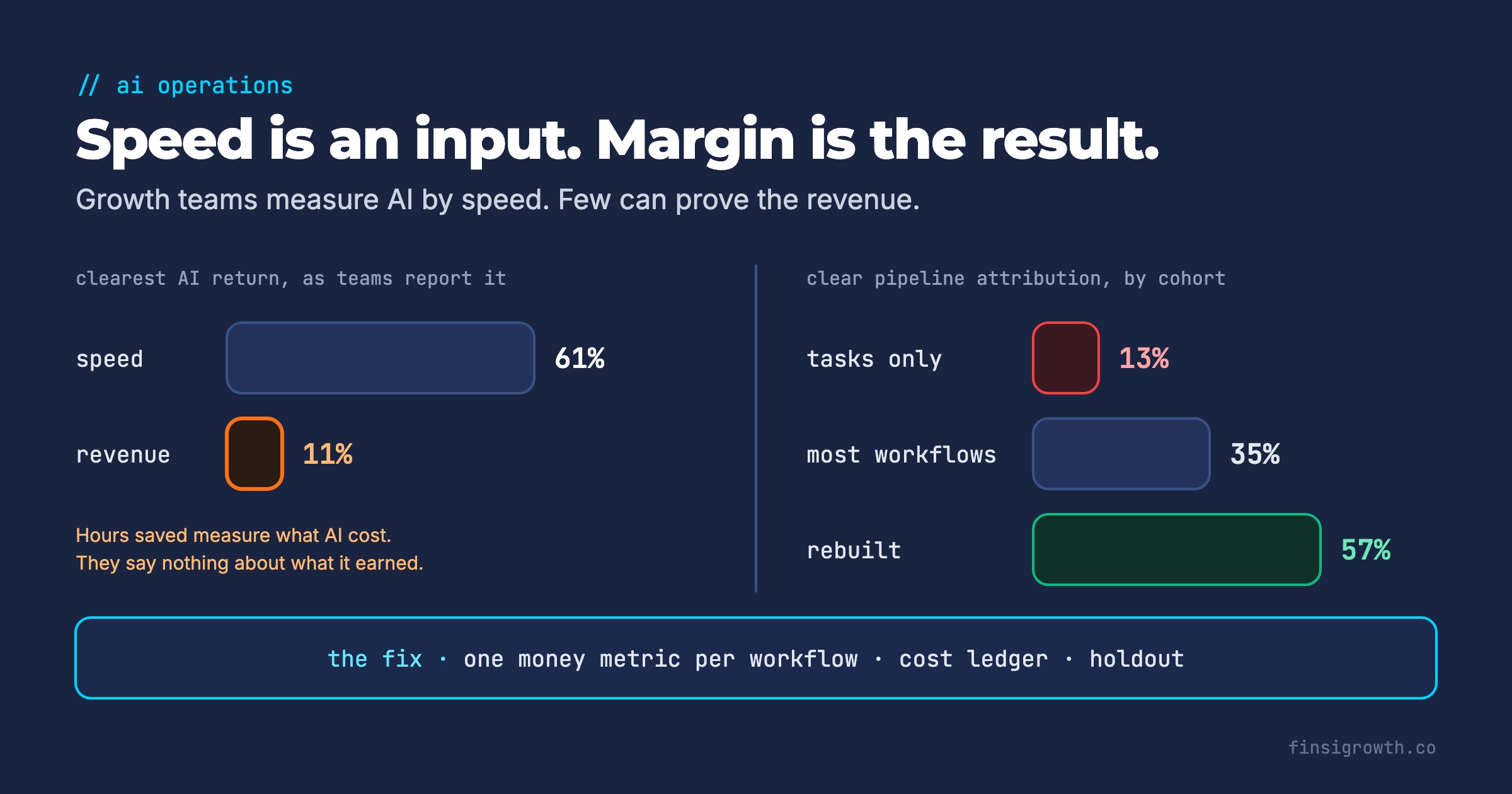
That’s the core finding of GrowthX’s State of AI-Led Growth 2026, a survey of go-to-market (GTM) teams. 61% say speed is their clearest return on AI. Only 11% say revenue or new business. One team in four has rebuilt how it works around AI, and that group pulls ahead on every metric the report tracks.
A word on the source before the numbers. GrowthX is a growth agency, and the report ends with a pitch for its services. It doesn’t publish a sample size. Respondents lean toward startup marketing teams: 30% are VP or Head of Marketing, 16% are founders, and stages run from bootstrapped (29%) through Series B+ (21%). That’s not a DTC sample. But the trap it describes looks the same in a Shopify brand, and in DTC the bill lands in contribution margin faster.
Key Takeaways
- In the survey, 61% of teams call speed their clearest AI ROI and 11% call it revenue. Speed is an input. Margin is the result.
- The 24% of teams who rebuilt their workflows around AI are the most likely to prove results: 57% have clear pipeline attribution, versus 13% of teams using AI only for tasks.
- More tools don’t fix measurement. Teams with 3–4 tools have 38% clear attribution, and teams with 5+ have 37%.
- 56% of teams lack precise visibility into their monthly AI spend, so they can’t calculate a return on it.
- Brand voice (47%) is now a bigger AI content problem than accuracy (39%). A written voice doc is the cheapest fix.
- For a DTC brand, the way out is to give every AI workflow one money metric, keep an AI cost ledger, and test against a holdout.
What did the State of AI-Led Growth 2026 survey find?
The survey sorts teams into three groups by how they describe their AI use. The further a team has rebuilt its workflows, the more likely it is to prove results, track AI search and have written guidelines.
| Cohort | Share of teams | Avg AI self-rating | Clear pipeline attribution | Track AEO | Documented guidelines |
|---|---|---|---|---|---|
| ”We use AI occasionally for specific tasks” | 31% | 6.0 / 10 | 13% | 18% | 17% |
| “AI is part of most of our workflows” | 44% | 6.9 / 10 | 35% | 51% | 25% |
| “We’ve rebuilt our processes around AI” | 24% | 8.4 / 10 | 57% | 67% | 59% |
The self-ratings are where it gets uncomfortable. Teams score themselves around 7 out of 10 across the board. The report’s own rule of thumb: if your self-rating is around 7 and your attribution is below 30%, you’re using AI to work faster, not differently.
Confidence doesn’t mean control either. Among high-confidence teams, 29% have no documentation at all. In that group, 73% call speed their ROI, 64% say editing time increased, and just 23% have clear attribution.
Why is speed the wrong way to measure AI ROI?
Speed tells you what AI cost you in hours. It doesn’t tell you what AI earned. The report found that 84% of teams measure AI ROI in speed, volume or time saved, and that teams measuring speed often chose it because it felt “safer.”
The volume numbers show the gap. Per 100 teams, 79 publish more content with AI. Only 37 can clearly prove which content drives pipeline. And 58% of teams whose #1 inbound channel is organic don’t have clear attribution on it.
Here’s what that looks like in a DTC brand:
- Ad creative. AI lets you ship 40 Meta ad variations a week instead of 8. But winners stay rare. Motion’s 2026 analysis of $1.29 billion in Meta spend found roughly 5% of creatives qualified as winners, taking 55% of spend (Motion, Creative Benchmarks 2026). More creatives means more tests. It only means more profit if you kill and scale ads on evidence.
- Email and SMS. Writing campaigns faster makes it tempting to send more of them. The number that matters is revenue per recipient against a holdout, not campaigns sent. Extra sends can cost you unsubscribes and deliverability.
- Product and SEO content. Fifty new pages is output. Conversion rate and revenue from those pages is outcome.
Speed is an input. Margin is the result. If the only number in your AI review is hours saved, you’ve measured the cost side of the equation twice and the revenue side not at all.
Does adding more AI tools fix attribution?
No. In the survey, clear pipeline attribution rises from 27% for teams with 1–2 tools to 38% at 3–4 tools, then stops. Teams with 5+ tools sit at 37%.
Tool sprawl also hides the cost side. 56% of all teams lack precise visibility into their monthly AI spend: 40% track it roughly and 14% don’t track it at all. Among teams with 5+ tools, 61% lack precise cost visibility. Among teams with 3–4 tools, that drops to 49%.
You can’t prove a return on a cost you haven’t measured. In a DTC P&L, AI subscriptions and usage fees are operating costs, the same as agency retainers or app fees. They belong on the same line, with an owner and a job attached to each one.
The decision: before you add a tool, name the metric it will move and the tool it replaces.
Is brand voice or accuracy the bigger AI content problem?
Brand voice. 47% of teams name it their top AI content challenge, ahead of accuracy at 39%. As the report puts it, hallucinations were the 2023 problem, and the 2026 problem is making AI sound like your brand.
The side effects show up in the workflow. 48% of teams say they publish slightly more with AI. 30% named skill loss as a top concern, yet 77% of that group already create written content with AI. The new costs they report:
- Strategic thinking gaps: 60%
- Quality tradeoffs: 53%
- Editing time: 53%
The fix is unglamorous: write the rules down once. 59% of rebuilt teams have documented AI guidelines, against 17% of task-only teams. Keep it short: one page on audience, positioning and banned phrases, one on tone, sentence length and headline patterns. Load both into every AI writing tool before it drafts a word.
For a DTC brand, the same doc should cover product claims you can and can’t make, discount language, and how you talk about ingredients, sizing or results. That’s where off-voice AI copy turns into refunds, chargebacks or compliance trouble, not just awkward phrasing.
What is AEO, and who should own it?
AEO (answer engine optimization) means getting your brand cited in AI answers from tools like ChatGPT, Perplexity and Google’s AI Overviews. The survey says most teams agree it matters and few have a system for it.
- 45% of teams are still figuring out their AEO strategy, at every funding stage.
- 12% assume their SEO carries over to AI search directly.
- 25% say “no tool” is their #1 barrier, and 79% of that group aren’t tracking AEO at all.
The sharpest split is by role. Only 17% of founders actively track AEO, against 62% of VP-level marketing leaders. Every founder who tracks it has a team of at least two. Among founders who don’t, 44% run marketing completely solo.
AEO doesn’t get done because nobody owns it. For a DTC brand, the useful test is simple. Once a month, ask the AI assistants the questions your customers ask before buying, like “best [your category] for [your customer’s problem],” and log whether you’re named, which competitors are, and which sources get cited. Give one person that job.
What do the rebuilt teams do differently?
The 24% who rebuilt their workflows share a consistent profile. Compared with everyone else in the survey:
| Trait | Rebuilt teams | Everyone else |
|---|---|---|
| Use Claude | 93% | 73% |
| Actively track AEO | 67% | 38% |
| Clear pipeline attribution | 57% | 27% |
| Documented AI guidelines | 59% | 22% |
One detail worth knowing: the report’s headline gaps (+44 points on attribution, +49 on AEO, +42 on guidelines) compare rebuilt teams with the task-only group. Against everyone else combined, the gaps are 30, 29 and 37 points. Smaller, still large.
Rebuilding isn’t enough on its own, though. 43% of rebuilt teams still can’t prove pipeline ROI. What separates the 57% who can:
- A unified view of content performance: 85% vs. 10%
- Completed documentation: 81% vs. 30%
- Precise AI cost visibility: 92% vs. 45%
Among teams without attribution, 90% call speed their top win.
Two caveats. This is self-reported survey data, so it shows correlation, not cause. Rebuilt teams may simply have more people and money. And the tool-brand number is probably a marker of how deeply a team has wired AI in, not the reason it gets results. The habits are the part you can copy: one view of performance, written rules and a known cost.
How does a DTC brand get out of the speed trap?
Run these five steps over the next two weeks. None of them needs a new tool.
- Build an AI cost ledger. List every AI tool and usage-based service, its monthly cost, its owner and the workflow it serves. Add it to the monthly P&L review.
- Give every AI workflow one money metric. Use the table below. If a workflow has no outcome metric you can measure, that’s the first thing to fix, not the tool.
- Test against a holdout. Compare AI-assisted work with what you did before, or with a control group, on the outcome metric. Klaviyo flows support A/B splits, and Meta has a built-in A/B testing tool.
- Write the voice doc. One page on audience, tone, banned phrases and claims you can’t make. Load it into every AI tool that writes customer-facing copy.
- Name an AEO owner. One person, one monthly prompt check, one log.
| AI workflow | Speed metric (what teams report) | Money metric (what to track) |
|---|---|---|
| Ad creative generation | Creatives shipped per week | Share of spend on ads under target CPA; new-customer CAC |
| Email and SMS copy | Campaigns sent | Revenue per recipient vs. holdout; unsubscribe rate |
| Product pages and SEO content | Pages published | Conversion rate and revenue from those pages |
| Customer support agent | Tickets closed | Refund and return rate; repeat purchase rate of contacted customers |
| Reporting and analysis | Hours saved | Budget or retention decisions changed because of it |
Then check everything against the account-level numbers. If AI workflows look great one by one but MER and contribution margin didn’t move, the workflow metrics are measuring activity, not results. Our retention metrics guide and e-commerce scaling scorecard cover the account-level numbers we check every week.
The decision for this month: pick your three biggest AI workflows and write down the money metric for each. If you can’t, you’re in the 76%.
If you’d rather have that measurement layer built and run against your real margins, that’s what Finsi Growth does for DTC brands. Or start with the free LTV Operating System guide.
Frequently Asked Questions
What is AI-led growth?
AI-led growth means redesigning how a marketing or growth team plans, produces, reviews and measures work around AI, not just using AI to finish existing tasks faster. In the GrowthX survey, only 24% of teams say they’ve done this.
Who ran the State of AI-Led Growth 2026 survey?
GrowthX, a growth agency, published it in 2026. Respondents are GTM leaders: mostly VPs and heads of marketing, growth leads and founders at companies from bootstrapped to Series B+. The report doesn’t state a sample size.
How should a DTC brand measure ROI on AI?
Tie each AI workflow to an outcome metric that reaches the P&L, like new-customer CAC, revenue per recipient or conversion rate, and compare it with a baseline or holdout. Then net the AI tool costs against the gain in contribution margin. Hours saved only count if they turn into lower costs or more revenue.
Do these findings apply to e-commerce brands?
Partly. The sample is startup GTM teams, not DTC brands, so don’t treat the percentages as DTC benchmarks. The pattern carries over: AI raises output faster than teams build the measurement to prove that output earns money.