Most stockouts at small DTC brands aren’t forecasting failures. They’re cash-timing failures. You pay a deposit months before the stock lands, pay the balance before you’ve sold a unit. Then the next order is due before the first one has paid back. So you under-order, and you run out.
Then the stockout spreads. Ads keep spending into empty product pages, subscribers miss boxes and cancel, and the CAC you planned on stops being true. Below, we map one purchase order to cash week by week and show what a stockout does to ad and retention economics. Then we give you a spend-versus-stock check to run every few days.
Key Takeaways
- With a 13-week lead time and a 50% deposit, the next purchase order is due before the first one has sold a single unit. That’s where under-ordering starts.
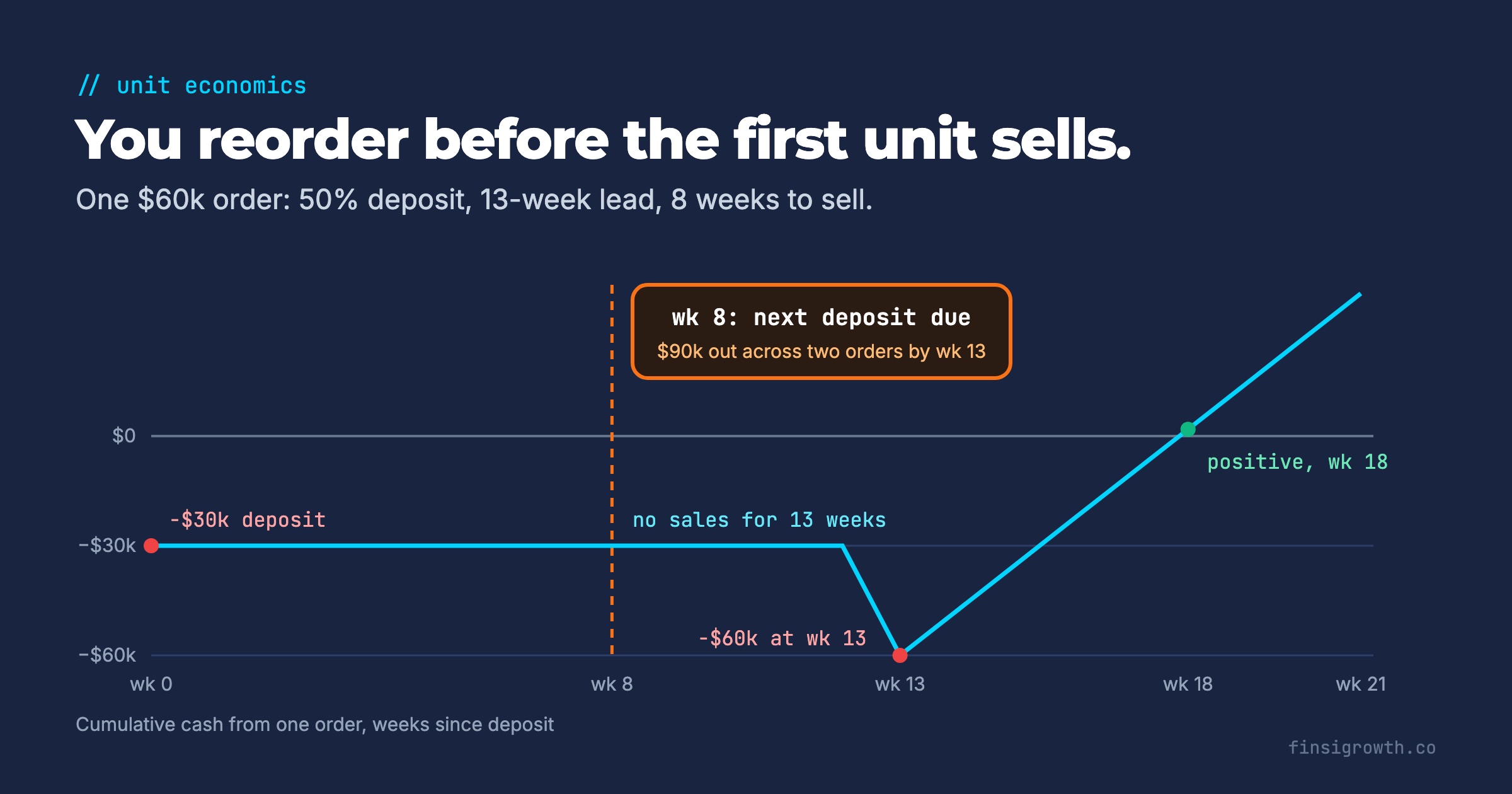
- In our worked example, cash from one $60,000 order turns positive 18 weeks after the deposit. The reorder point arrives at week 8.
- Stockouts break ad economics three ways: spend on unbuyable products, lost learning when you pause, and churn from customers who couldn’t get what they paid for.
- Recheck ad spend against stock every 3–4 days. Cap spend on any SKU whose days of cover run shorter than the time to restock.
- Fix the cash side with supplier terms, prepaid plans and forecast bands, not just a better spreadsheet.
Why is a stockout a cash-flow problem?
Inventory is cash you’ve spent and can’t use until it sells. The longer your lead time, the longer that cash sits in a container, a warehouse or a supplier’s queue. Every week of lead time is a week you’re financing your own product.
Founders tell us this in their own words. A supplement brand we worked with in 2025 had a 13-week lead time. After an ingredient problem caused a stockout, the founder admitted: “I’ve always underordered… because ordering costs money.” Another operator described net terms plus card float like this: you buy in late March and pay in July, then ask “where did my money go?” A third, with seasonal production runs, said the hard part was “trying to figure out who to pay first.”
Over-ordering has its own cost. One subscription brand forecast 10% growth and got a 5% decline instead, which left it with an inventory glut. A soap maker bought drums of essential oil when 50 pounds would have done, and got “caught holding the bag.” A subscription box sourcing from small vendors framed the dilemma best: “What’s worse? Not selling or having stuff?”
Both mistakes have the same root. The order size was set by how much cash was free that week, not by what demand needed.
What one purchase order does to your cash, week by week
Here’s an illustrative purchase order, built from terms we see often across brands we work with:
- $60,000 order at landed cost, with 50% deposit at order and 50% when it ships.
- 13-week lead time from deposit to sellable stock.
- $180,000 of retail value, so COGS is a third of revenue.
- 8 weeks to sell through, at $22,500 of revenue a week.
- Shipping and fees at 15% of revenue, and ad spend at 30% of revenue, a MER of about 3.3.
That leaves $12,375 of cash per sales week after shipping, fees and ads. Here’s the running cash position for that one order:
Now the trap. If the stock sells out at week 21, the next batch has to land at week 21. With a 13-week lead time, that deposit goes out at week 8. At week 8, you’re $30,000 out and you haven’t sold anything. By week 13 you’d be $90,000 out across two orders.
Most small brands don’t have $90,000 sitting idle. So they wait for the first batch to start selling, place a smaller second order, and plan to stock out. Nobody calls that a cash decision. It shows up later as an “inventory problem.”
The decision it drives: your peak cash need is not one purchase order. It’s one order plus the deposit on the next, carried until the first one pays back. Work that number out before you plan the next marketing push.
How do stockouts wreck ad economics?
A stockout changes your CAC, your conversion rate and your retention at the same time. Most dashboards only show the first one, and late.
1. You pay for clicks nobody can convert
Ads don’t know a product sold out. They keep spending until someone pauses them. One brand we spoke with first heard about stockouts from “where’s my order?” tickets. Its store, ERP and warehouse system rarely matched, so nobody saw the empty shelf in time. If a sold-out SKU is in your best ad set, that ad set’s CAC climbs every day it runs.
2. Pausing has a cost too
The obvious fix is to pause. That’s right when stock is gone for weeks, because the alternative is worse. A subscription box operator we work with put it this way. Keep running ads on a sold-out offer, and Meta learns “these people don’t want to buy.” But a pause also throws away learning. When you restart, you pay for a new learning phase, at a time when you’re short of cash. The learning-phase budget math shows what that restart costs at small budgets.
3. Customers who can’t get the product leave
This is the expensive one. A fish-oil subscription brand told us its stockouts drive subscription churn. Another brand said inventory gaps drove churn, then asked, “Is it too late to win them back?” Another subscription brand told us this spring that stockouts, a cold winter and Black Friday order pull-forward together left recurring revenue 10–11% below plan in February. A fourth turned off its satisfaction surveys “until we don’t have stockouts,” with several hundred orders on hold.
Overselling subscriptions does the same damage more slowly. You keep acquiring subscribers you can’t ship, deliveries slip, and the reviews arrive a few weeks later. Each of those customers cost you a full CAC and may never reach the repeat orders that made the CAC worth paying. If your break-even depends on 12-month repeat profit, as we laid out in the two break-even CAC numbers, a stockout can quietly erase it.
The decision it drives: count stockout weeks as a cost of acquisition. If a cohort was acquired just before a stockout, expect its retention to lag, and don’t blame the email program first.
Sell, delay or pause? A decision table
Not every stockout should stop sales. The right move depends on how long the gap lasts and who the customer is.
| Situation | What to do | Why |
|---|---|---|
| Restock lands in 1–2 days | Keep selling, and set a clear ship-by date | A short delay costs less than a “sold out” badge |
| Restock is 1–4 weeks out | Pause ads on that SKU and shift spend to in-stock products | Protects CAC without restarting the whole account |
| Restock is a month or more away | Pause the SKU’s campaigns and run a back-in-stock list | Spend into an empty page trains the algorithm on non-buyers |
| Subscribers due a sold-out product | Offer a swap or a substitute, and charge accordingly | A missed box is a cancel trigger |
| Packaging, not product, is short | Repackage with what you have | One brand used slower SKUs’ bags with stickers during a 3-week packaging gap |
For the first row, Shopify lets you keep selling a tracked product at zero stock with its “Continue selling when out of stock” setting (Shopify Help Center). Say the ship date on the product page and in the order confirmation.
For subscribers, a substitute beats a skip. One idea we raised with a subscription client this week: during a stockout, charge 50% and ship a substitute, so the billing cycle and the habit both survive.
Use the gap. A supplement brand we worked with in 2025 sent Kickstarter-style updates during its stockout, which kept its audience warm. Our advice at the time was “never waste a crisis.” Call your best customers personally while you wait for stock.
Client results are specific outcomes, not typical or guaranteed.
Recheck ad spend against stock every 3–4 days
Days of cover is how many days your on-hand stock lasts at the current sales rate. Compare it with the days until your next restock. If cover runs out first, your ad budget is selling stock you don’t have.
Days of cover = (units on hand − safety stock) ÷ units sold per day
Then turn it into a spend ceiling for that SKU:
Max daily ad spend = (sellable units per day until restock − organic and repeat units per day) ÷ units per new order × CAC
Worked example. A SKU has 1,200 units on hand and 200 in safety stock. Restock lands in 30 days. Repeat and organic orders use 15 units a day. New orders average 1.5 units, at a $50 CAC.
- Sellable units per day until restock: 1,000 ÷ 30 = 33.3.
- Left for new customers: 33.3 − 15 = 18.3 units, or about 12 new customers a day.
- Max daily spend: 12.2 × $50 = about $610.
Now suppose you’re spending $1,000 a day. That buys 20 new customers and 30 units, plus 15 organic, for 45 units a day. You’ll hit safety stock in about 22 days, 8 days before the restock. At that point you either stock out or pause, and pay for both problems.
We recommend this check every 3–4 days, not monthly. Sales rates move with every budget change, and a weekly review can miss the moment cover drops below lead time. Put it next to your contribution margin numbers, so the people who set spend see stock at the same time.
The decision it drives: if days of cover fall below days to restock, lower spend on that SKU to the ceiling. Raise it again only when the next batch has a confirmed ship date.
How do you fix the cash side?
Better forecasts help, but they don’t create cash. These levers do:
- Negotiate terms, not just price. The supplement brand above moved to 50% at order plus eight weekly installments. Spreading the balance pulls your cash curve up during the lead time.
- Forecast as a band. One operator we spoke with this spring forecasts with confidence bands. At a 30% MER, there’s a 95% chance April lands between $2.8M and $5M, and a 50% chance it lands between $3.7M and $4.1M. Order to the edge of the band you can afford to be wrong on.
- Bring cash forward with prepaid plans. A subscription box we work with is considering offering long-tenure monthly subscribers a switch to 3- or 6-month prepaid. That means cash up front and less churn.
- Treat retention as working capital. As one operator told us in June, better retention means more cash, which means more acquisition. A repeat order needs no new CAC, and it pays for the next PO.
- Separate DTC from wholesale demand. One brand put most of its stock into a big-box retailer during a shortage, and its DTC customers went without. Our warning on a call that week: once you’re in Target, “you start working to make Target happy, not your customers.”
Lead times don’t only apply to product. One brand we spoke with this spring has an 8–12 week lead time on packaging alone. Map every component with a lead time longer than your sell-through, because each one is a stockout waiting to happen.
What to do this week
- List your top 10 SKUs by revenue. For each, write down units on hand, safety stock, daily sales and the confirmed restock date.
- Compute days of cover and the spend ceiling. Flag every SKU where cover runs out before restock.
- Map ad sets to SKUs. If a flagged SKU sits in a top ad set, cap it or shift spend to in-stock products before the shelf empties.
- Build the cash curve for your next PO. Deposit date, balance date, landed date, sell-through weeks. Find your peak cash need, including the next deposit.
- Ask your top two suppliers about terms. Installments or a later balance date can be worth more than a unit-price discount.
- Pull churn for any cohort that lived through a stockout. Compare it with a cohort that didn’t, at the same age. That gap is your stockout cost.
- Put a 3–4 day spend-versus-stock check on the calendar. Give it one owner, and make sure that person can change ad budgets.
Closing: plan marketing against stock and cash
ROAS doesn’t know what’s on your shelf. Your CAC and your LTV both assume the product is there when the customer clicks. Plan every marketing push against two numbers: days of cover and peak cash need. If either one says no, the campaign waits.