Angel Olavarria, founder of skincare brand Strive Skin, rebuilt his website, Amazon listings, Klaviyo flows, blog and SEO plan in 60 days, without hiring anyone. He did it with ChatGPT, Claude, Midjourney and Figma, plus 12 weeks of 1:1 coaching.
The story comes from a case study published by MasteringAI, the coaching company that ran the program. Its headline numbers: $78,000+ in deliverables, 5–6x productivity and conversions up 250%+.
It’s a sales page, so read it like one. The build is real and worth copying. The valuation is the pitch. Here’s what a DTC founder can take from it, and how to measure the same kind of build in contribution margin instead of agency invoices.
Key Takeaways
- Strive Skin’s first two weeks went into a brand system: voice guide, content style docs and design foundations. Everything built later reused it. That’s the most copyable part.
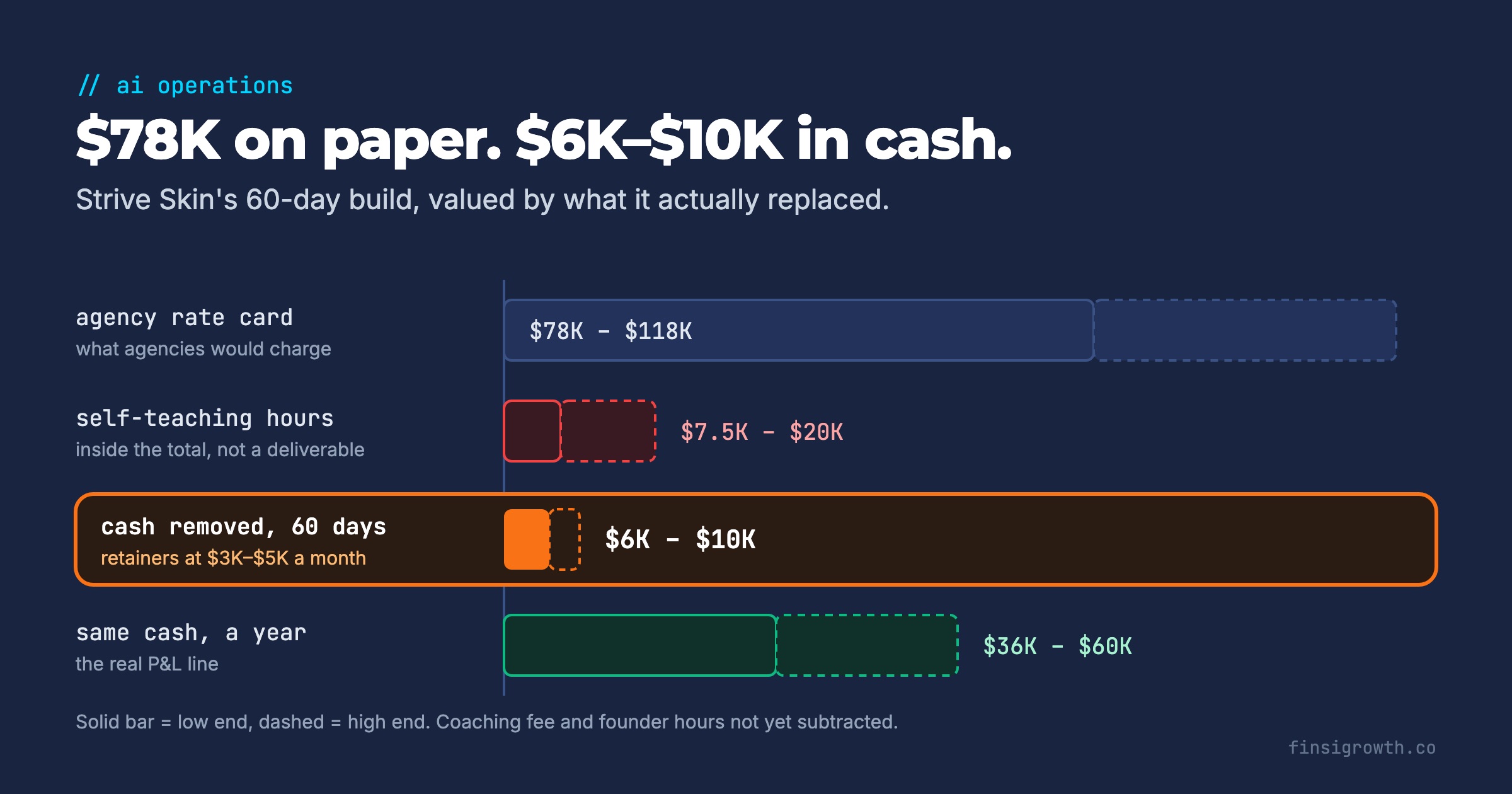
- The $78K–$118K figure is what agencies would have charged, not cash saved. It includes $7,500–$20,000 for “self-teaching hours saved,” which isn’t a deliverable.
- The cash test is simpler: the founder was paying agencies $3,000–$5,000 a month. That’s the spend AI can actually remove.
- The 250%+ conversion lift appears in the headline only. There’s no baseline, channel, time window or traffic number, so you can’t evaluate it.
- If you run this playbook, record a baseline before you ship each asset, and judge it on revenue per session, revenue per recipient or unit session percentage.
What did Strive Skin build in 60 days?
Ten deliverables across five channels, in six two-week blocks. The founder did the work. The coach set the order and the methods.
| Weeks | What got built | Time it took | Agency price quoted |
|---|---|---|---|
| 1–2 | Voice and tone guide, content style docs, design system foundations | ~1 week | $8K–$15K |
| 3–4 | 13-section website redesign, shop page with product grid, mobile optimization | ~2 days + ~3 days | $15K–$25K + $5K–$8K |
| 5–6 | Amazon A+ content (9 panels, 4 tabs), 7–9 listing images per SKU, brand story carousel | ~1 day per product each, ~4 days for the carousel | $3K–$5K + $2K–$4K per product, $3K–$5K |
| 7–8 | 3 automated Klaviyo flows, 9+ branded emails | ~1 day per flow | $4K–$6K per flow |
| 9–10 | Blog architecture, content templates, auto table of contents | ~1 week | $8K–$12K |
| 11–12 | SEO audit and content gap plan (131K monthly search volume analyzed), legal and competitive research | ~3 days + ~2 days | $5K–$8K + $3K–$5K |
The tool split is worth noting. Midjourney generated product and listing images, Figma assembled the final ad and listing assets, and Claude worked as what the founder calls his creative director: “it was my creative director and helped me fully ideate everything.”
What made the build work?
The case study names three shifts. Only the first one depends on you, not the coach.
- From tasks to systems. Before coaching, Angel spent 3–4 hours a day in ChatGPT on research, basic copy and brainstorming. One-off prompts start from zero every time. The fix was persistent context: brand docs, a design system and content guidelines that every later session reused.
- From drafts to deliverables. The old output was a Google Doc that needed about six more hours of work. The new output was a live page, a coded email or a finished listing, shipped the same day.
- From self-teaching to guided practice. Weekly sessions replaced trial and error. The founder’s own estimate: “it would have taken 6 months instead of 2.”
Look at the order. Weeks 1–2 produced no customer-facing asset at all. They produced the rules every later asset followed. That’s why a website could go up in two days and an Amazon listing in one: the voice, claims and visual system were already decided.
This matches what bigger surveys show. In GrowthX’s State of AI-Led Growth 2026, 59% of teams that rebuilt their workflows around AI had documented guidelines, against 17% of teams using AI for one-off tasks. We broke that report down in The AI Speed Trap.
For a skincare brand, the brand doc has one more job: claims control. The FDA decides whether a product is a cosmetic or a drug by its intended use, and label and ad claims set that use. Claims like treating acne or regenerating cells make a product a drug (FDA). An AI tool writing 9 emails and 9 listing images a week will happily write “clears breakouts” unless your doc forbids it.
The decision: write your brand system before you let AI build anything a customer sees.
Is $78K the right way to value it?
No. $78K–$118K is what agencies might have charged for the same list. It’s not what the business saved, and it’s not what the business earned.
Three things to separate:
- Rate-card value. The total prices each deliverable at agency rates. That’s only money saved if you would really have bought it. Would a solo founder have paid $15K–$25K for a redesign this quarter? Maybe. Maybe not.
- Counterfactual time. One line item, “self-teaching time saved (150–200+ hours),” is valued at $7,500–$20,000. It’s the founder’s estimate of hours he would have spent learning alone. It isn’t a deliverable, and it’s a big share of the total.
- Cash actually removed. The case study says $150-an-hour work was going to agencies at $3,000–$5,000 a month. Cancel those retainers and that’s $6,000–$10,000 over the 60 days, or $36,000–$60,000 a year. That’s real money on the P&L.
The cost side is missing too. The coaching fee isn’t disclosed. And by the case study’s own time estimates, the builds took at least 33 working days of founder time, counting one product’s Amazon content. That’s most of the working days in a 60-day stretch. A founder’s hours are the scarcest input a $1M–$5M brand has.
None of this makes the build less impressive. It makes the number less useful. The value of a new website isn’t its agency price. It’s the extra gross profit per session it produces, for as long as it runs.
The decision: value AI-built work by the retainer or project spend it actually replaces, minus tool and coaching costs, minus the founder time it uses.
What about the 250% conversion lift?
It’s the biggest number on the page, and it’s in the headline only. The body never says which conversion rate, on which channel (Shopify store or Amazon), over which period, or on how much traffic.
That matters because a conversion lift on a small base can be real and still misleading. A store that converts 0.8% of 2,000 monthly sessions makes 16 orders. A +250% lift takes it to 2.8%, or 56 orders. If the lift is real, it’s worth a lot. But at 16 orders a month, random swings of around 8 orders happen with no change at all.
Even “250%” is ambiguous. “Up 250%” means 3.5 times the old rate. Many people write it when they mean 2.5 times. The case study doesn’t say which.
Before you believe any conversion lift, yours included, check five things:
- Same window length, same season. Compare 28 days against 28 days, ideally year over year.
- Same traffic mix. If paid social shrank and email or branded search grew, conversion rate rises with no site change. Compare by traffic source.
- Enough orders. Under about 100 orders per period, treat any lift as a hint, not a result.
- Revenue per session, not just conversion rate. A redesign that converts more but drops AOV can leave revenue flat.
- Margin. Check that the lift didn’t come from a deeper discount running at the same time.
The decision: no conversion claim goes in a deck, or a budget decision, without the baseline, the window and the order count next to it.
How do you run this playbook in your own brand?
Copy the build order. Add the measurement the case study skipped. Five steps:
- Write the brand system first. Voice, banned phrases, product claims you can and can’t make, discount language, visual rules. One week, once.
- List what you pay outside help to produce. Retainers, freelancers, per-project agency work. Rank by monthly cash. Those are your first AI builds, because the savings are real.
- Record a baseline before you ship. Pull the metric in the table below for the 28 days before each asset goes live.
- Ship, then compare on the money metric. Use an A/B split where the platform supports it: Klaviyo supports A/B tests on flow emails, and Amazon offers Manage Your Experiments for A+ content on eligible brand-registered ASINs.
- Keep a ledger. Tool subscriptions, coaching or training fees, and founder hours on one side. Cancelled spend and margin gained on the other.
| What you build | Speed metric (what case studies report) | Money metric (what to track) |
|---|---|---|
| Website or shop page redesign | Days to launch | Conversion rate and revenue per session, by traffic source |
| Amazon A+ content and listing images | Listings shipped | Unit session percentage (units ordered ÷ sessions, in Business Reports), TACoS |
| Klaviyo flows | Flows and emails built | Revenue per recipient vs. a holdout; unsubscribe rate |
| Blog and SEO content | Pages and templates built | Organic sessions to product pages; revenue from those sessions |
| Brand and content guides | Documents written | Edit time per asset; assets rejected for being off-brand or off-claim |
Then check it against account-level numbers. If every build looks good on its own but MER and contribution margin didn’t move, the builds changed activity, not results. Our retention metrics guide and e-commerce scaling scorecard cover those numbers.
The decision for this month: pick the one agency line you pay for most. Build its replacement in-house, with a baseline recorded first.
If you’d rather have that measurement layer built and run against your real margins, that’s what Finsi Growth does for DTC brands. Or start with the free LTV Operating System guide.
Frequently Asked Questions
What is the Strive Skin AI case study?
It’s a case study published by MasteringAI, an AI coaching company, about its client Strive Skin, a DTC skincare brand. Over 12 weeks of 1:1 coaching, the founder used ChatGPT, Claude, Midjourney and Figma to rebuild the brand’s website, Amazon listings, Klaviyo flows, blog and SEO plan in-house.
Did Strive Skin save $78,000?
Not in cash, as far as the case study shows. $78K–$118K is the estimated agency price of the work, including $7,500–$20,000 for self-teaching time saved. The founder’s reported agency spend was $3,000–$5,000 a month, which is the cash AI could actually replace.
Can a solo DTC founder replace an agency with AI?
For production work like pages, listings, emails and content, this case suggests yes, if you build a brand system first and have the time. It took most of the founder’s working days for two months. Judge the result on margin per session or per recipient, not on deliverables shipped.
How do you measure ROI on AI-built marketing assets?
Record the money metric before launch, such as revenue per session, revenue per recipient or unit session percentage. Compare it after launch over a matched window or against a holdout. Then net out tool, coaching and founder-time costs, and count only the outside spend you actually cancelled.