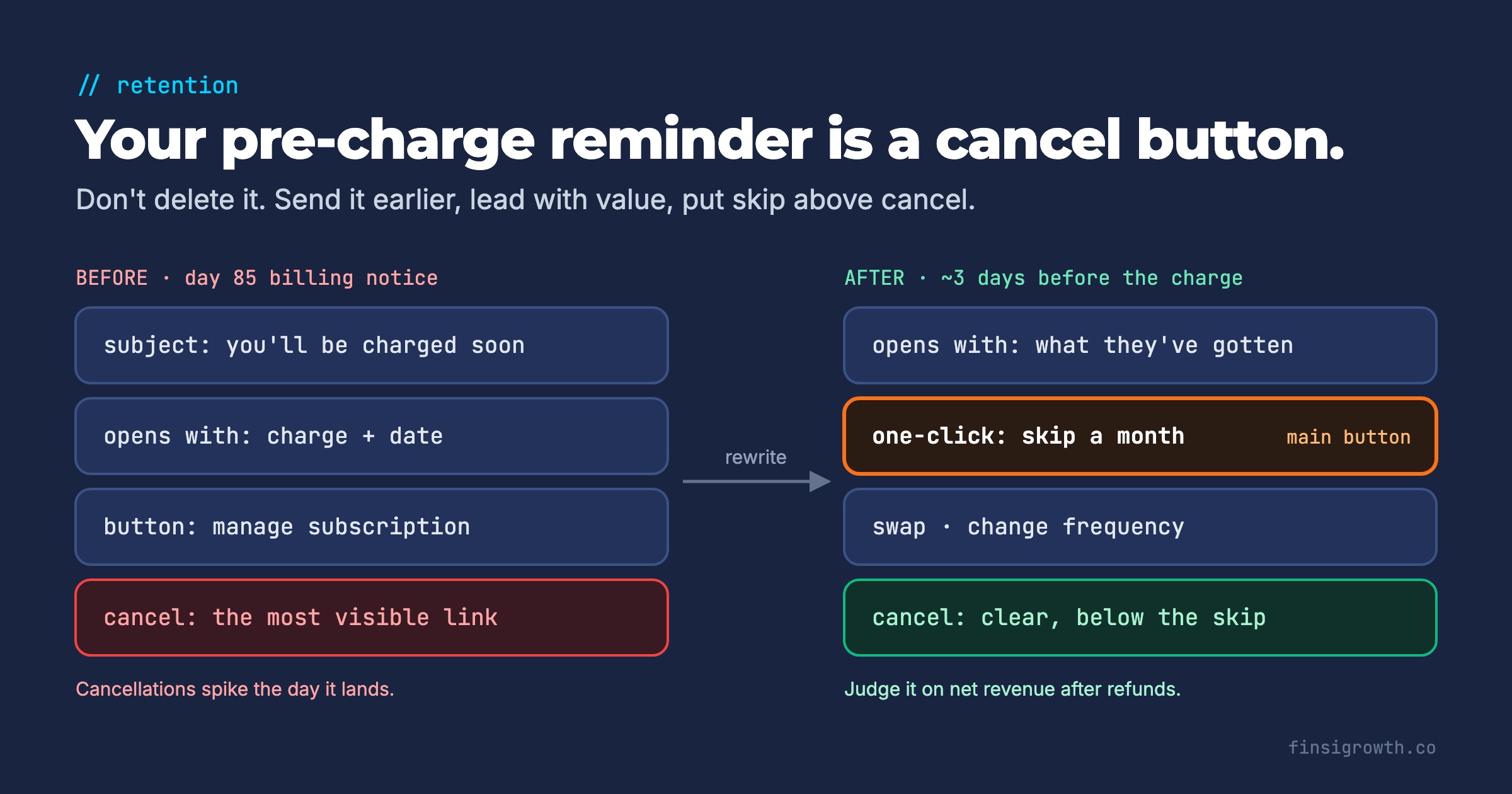
Plot your subscription cancellations by day since signup and you’ll usually see the same shape. There’s a spike on day one, a spike on renewal day, and a second spike a few days before renewal. That last one lines up, almost to the day, with the “your order is coming up” email. The subscriber didn’t fall out of love on day 85. Your email reminded them they could leave.
The tempting fix is to stop sending it. Don’t. Some subscribers who would have cancelled after the reminder will be charged, then ask for a refund or dispute the charge. Instead, rewrite the email so it does a different job. Send it a little earlier, lead with what they’ve gotten, and make skipping easier than cancelling. Here’s what we’ve seen in client and discovery calls, and the template we use.
Key Takeaways
- Map cancellations by day since signup. In brands we’ve reviewed, the biggest spikes sit at day one, renewal day and the day the pre-charge reminder lands.
- Early renewals carry most of the risk. Recharge data shows about 61% of voluntary cancellations happen at the first two renewals.
- Deleting the reminder trades visible cancellations for refunds, chargebacks and support tickets. And state auto-renewal laws may require certain notices anyway.
- Rewrite it: send about three days before the charge, open with the value delivered, put a one-click skip at the top and keep cancel clearly available.
- Test content and timing against a holdout. Judge it on net revenue after refunds and chargebacks, not on cancellations alone.
What does the cancellation heartbeat look like?
A cancellation heartbeat is a chart of cancellations by day since the subscription started. It shows when people leave relative to billing and messaging events, not just how many leave. We build it for every subscription client because it turns “churn is high” into “churn is high on these three days.”
Here’s what it showed across brands from our client and discovery calls in June and July. Client results are specific outcomes, not typical or guaranteed.
| Brand (category) | Plan | What the heartbeat showed | Source |
|---|---|---|---|
| Men’s grooming refill subscription | 90 days | About 5% cancel on day one. Biggest spike at day 90, the charge. Second big spike around day 85, the day the upcoming-charge email goes out | Client audit, July 2026 |
| Electrolyte drink subscription | Monthly | Most cancellations land two days before renewal | Client audit, July 2026 |
| Supplement brand (data walkthrough) | Monthly | Spike at day 33, right after the second billing, then a cluster around day 50 | Discovery call, July 2026 |
| Book-and-drink subscription box | Monthly | The renewal email “as usual” produced an unsubscribe and cancel spike | Client sync, July 2026 |
| Frozen-food subscription | 4, 6, 8 weeks | Cancel spike around day 36, when the second box arrives and people remember they’re subscribed | Client call, June 2026 |
The grooming brand’s operator confirmed it on the call: day 85 is when the “you’ll be charged soon” email goes out. The frozen-food case is a useful variant. The trigger there wasn’t an email but the second box landing. The pattern is the same. Any moment that reminds a subscriber they’re on a plan is a decision point.
Day-one cancels are a different problem. When we see a big day-zero spike, it usually means deep-discount buyers or people who didn’t realize they’d subscribed. We’ve written about that in discount depth and cohort quality. This post is about the renewal spike.
Why are the first renewals the riskiest?
Most voluntary cancellations cluster in the first few billing cycles, so the first pre-charge reminders are the ones that matter most. Recharge analyzed active churn by billing cycle. It found that about 61% of all voluntary cancellations happen at the first two renewals, and roughly 72% within the first four (Recharge, July 2026).
That matches what the grooming brand’s chart showed and what we heard elsewhere. A tea brand told us in June that “once they’re three, we’re in a much better cadence.” An electrolyte brand told us retention stabilizes after the third order. So the reminders before renewals one and two deserve far more care than the reminder before renewal ten. “Defend the first renewal” became our shorthand on these calls.
This also changes how you read churn rate. A blended monthly number hides that most of the loss happens in a few predictable moments. Track churn by order number, the way we suggested for the second and third order, and you’ll see where the reminder sits.
Why not just stop sending the reminder?
Because the subscribers who cancel after a reminder were mostly leaving anyway, and catching them after the charge costs more. That’s the position we took with a protein-shake subscription in June. A subscriber who’s charged without warning and didn’t want the order rarely becomes a happy customer. They email support for a refund, or they dispute the charge with their bank.
Operators feel the tension. A dog subscription box told us in February that it sends only the legal minimum, because “if you are emailing them, cancellations go up.” It’s a fair observation. But it’s a trade-off against chargebacks and support tickets, and those don’t show up on a cancellation chart. If you judge the reminder only on cancellations, deleting it will always look like a win.
There’s a compliance side too. This isn’t legal advice, so check your own obligations with counsel. But the rules haven’t gone away:
- The federal rule was vacated, not the law. On July 8, 2025, the Eighth Circuit vacated the FTC’s click-to-cancel rule on procedural grounds. The FTC can still act under ROSCA and Section 5 of the FTC Act. More than half of states have their own auto-renewal laws, many as strict as the vacated rule or stricter (Greenberg Traurig, July 2025).
- California added annual reminders and price-change notices. Amendments effective July 1, 2025 require an annual reminder covering the product, charge frequency and amount, and how to cancel. A price change needs clear notice no less than 7 and no more than 30 days before it takes effect (Kilpatrick, October 2024).
- Save offers come with conditions. Under the same amendments, offering a discount during online cancellation requires a prominent, continuously displayed “click to cancel” link or button.
So the question isn’t “reminder or no reminder.” It’s what the reminder says, when it lands, and what it makes easy.
How do you rewrite the pre-charge reminder?
Turn it from a billing notice into a value recap with a skip button. This is the rewrite we gave the grooming brand in July. We’ve since used the same structure with other subscription clients.
| Element | Before (typical) | After (rewrite) |
|---|---|---|
| Timing | A few days before the charge, whenever the billing app defaults | About 3 days before the charge, on a day you choose and test |
| Subject line | ”Your order is coming up” / “You’ll be charged soon” | Lead with the subscriber’s benefit or the next box (“Your next refill ships Friday”) |
| Opening | Charge amount and date | What they’ve gotten so far (“three months of refills, zero trips to the store”) |
| Primary action | ”Manage subscription” | One-click skip: “Still have some left? Skip a month” |
| Secondary actions | Cancel link | Swap product, change frequency, add an item to the next box |
| Cancel | Often the most visible link | Clearly available, never hidden, below the skip |
| Offer | None | Optional, tested: 10% off or free shipping on the next cycle |
| Required details | Sometimes missing | Charge amount, date, frequency and how to cancel, in plain text |
A few notes on each part:
Timing. Three days gives people time to skip without making the email feel like a countdown. A dog-treat subscription we spoke with in June landed on 3 to 5 days ahead. The right number depends on your shipping lead time, so test it.
Value first. On the grooming call, we suggested opening with something like “we had an amazing three months with you.” The point is to remind them why they subscribed before you remind them what it costs. If you have usage or replenishment data, use it: “most subscribers start running low around now.”
Skip beats cancel. The protein-shake subscription’s version added “skip 1 to 2 weeks if you still have product.” A skipped order is revenue delayed. A cancellation is revenue gone, plus a win-back campaign to pay for. A dog subscription box showed how much demand there is for a softer exit. Its cancel-page save flow saved 52 subscribers, then 122 a few weeks later. The top choice was a two-month pause. (Client results are specific outcomes, not typical or guaranteed.)
The offer is optional. Test a 10% or free-shipping offer carefully, and only after the skip is in place. We’ve written about why perks beat discounts for subscribers. A reminder that trains people to wait for a discount just moves the cancel spike.
What can go wrong with skip?
Skip can turn into a quiet way to cancel. An operator told us in March that a brand’s LTV dropped after it added a skip button, because everyone found it. Indefinite pauses are worse. In our experience, subscribers on open-ended pauses rarely come back.
So put limits around it:
- Offer a defined skip (one cycle, or one to two weeks), not “pause until I come back.”
- Track repeat skippers. Someone who skips twice in a row probably needs a longer frequency, not another skip.
- Count skips in your revenue forecast. Your churn rate can look better while MRR slips, because skipped orders don’t ship.
The goal isn’t to prevent every cancellation. It’s to keep the people whose only problem was timing.
What about payment failures after the reminder?
The reminder and dunning are two halves of the same billing event. A reminder that tells people to update their card before the charge prevents some failures entirely. Once a charge fails, the playbook is different: route by decline code, retry soft declines near paydays, and match the message to the failure. We covered that in dunning by decline code.
How do you test it?
Run a holdout and judge it on net revenue per subscriber, not on cancellations. A cancellation-only scorecard will always favor sending nothing.
Here’s the test design we use:
- Split eligible subscribers at their next renewal into the current reminder and the rewrite. Where the law in a subscriber’s state may require a notice, test the content and timing only. Don’t test sending nothing.
- Measure four outcomes per group over the next two cycles: cancellations, skips, refunds and chargebacks, and orders shipped.
- Compute net revenue per subscriber: charged revenue minus refunds, chargeback losses and fees. Use net revenue, not gross.
- Read the heartbeat again. If the rewrite works, the spike around the reminder should shrink or turn into skips.
One warning from the book-and-drink box. It redesigned its reminder in 2025, adding add-to-next-box items and moving the cancel link to the bottom. The spike around the reminder was still visible afterward. Layout alone didn’t change it. Timing, the value message and the skip option are what we’d test first.
What to do this week
- Build the heartbeat. Export cancellations with subscription start date and cancel date. Chart cancellations by day since start, by plan length.
- Mark your events on it: charge day, reminder send day, shipping or delivery day. Note which spikes line up.
- Pull the current reminder and check it against the “before” column. Note your billing app’s default send timing.
- Write the rewrite using the table above: value opening, one-click skip as the main button, cancel clearly available, required billing details.
- Check your obligations for annual reminders, price-change notices and cancellation offers with counsel, especially for California subscribers.
- Launch a holdout test on renewals one and two first, since that’s where most voluntary cancellations happen.
- Add refunds and chargebacks to your churn report so the next decision about the reminder uses net revenue.
A reminder is a moment. Use it.
Every billing event is a decision point. You can’t stop subscribers from noticing the charge, and you shouldn’t try. What you can control is what they see at that moment: what they’ve gotten, what’s coming, and how easy it is to skip instead of leave. Rewrite the email, test it against net revenue, and defend the first renewal.