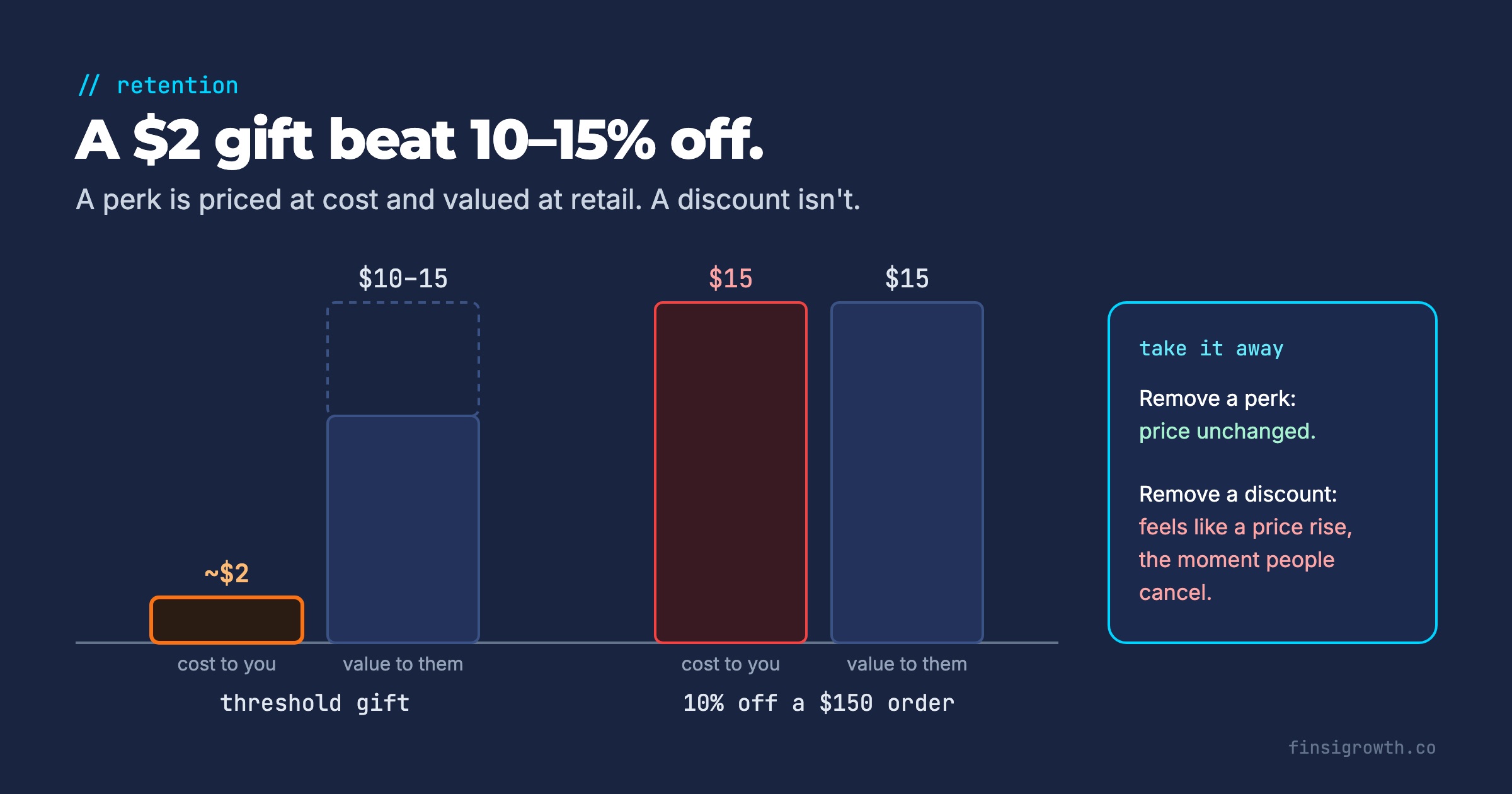
A discount rewards someone for arriving. A perk rewards them for staying. That’s the whole difference, and it’s why subscription brands that swap percentages for gifts, tiers, exclusives and small box upgrades tend to keep better customers at lower cost.
Across brands we work with, the evidence keeps lining up. A ~$2 gift outsold a 10–15% discount at a frozen-food brand. A VIP tier’s members reached a median LTV about three times that of regular subscribers. The hard part isn’t believing it. It’s getting off discounts without a hole in next month’s cash.
Key Takeaways
- A perk costs you COGS. A discount costs you price. A $2 gift on a $150 order costs far less than 10% off, and it doesn’t reset what customers think the product is worth.
- The perks that worked in our client data: threshold gifts, tenure milestones, VIP tiers, members-first exclusives and cheap box upgrades like a 20-cent sticker.
- VIP members look far more valuable, but they also self-select. Compare against a matched group before crediting the tier.
- Perks aren’t universal. One dog subscription box found gift-with-purchase offers barely moved cold Meta traffic. Show the gift’s dollar value, and test it with customers first.
- Don’t cut sitewide discounts cold. Replace each sale slot with a non-discount event, step the depth down, and keep a holdout so you can see the real cost.
Why do percentages recruit cancellers?
Because the offer decides who signs up. In our February post on discount depth, a $5 first-box cohort renewed at about 40% against 70–90% for normal cohorts. Fresh calls keep adding examples.
A functional-edibles brand ran an April sale that brought in about 400 customers a day and 725 new subscriptions. 101 of those subscribers cancelled right after receiving the product. A large tea brand told us zero-day cancels run at 12–15% of its subscription orders.
The tea brand’s team summed up the deeper cost on a call in April. Its customers, they said, “are trained, and it has nothing to do with how they actually consume tea.” Customers had learned to wait for the next 20% email rather than reorder when they ran out.
A percentage also stacks against you over time. It’s applied to every order, it grows with AOV, and it lowers the reference price customers carry in their heads. A perk is a fixed cost that you control.
What does a perk do that a discount can’t?
Three things, all of which show up in contribution margin:
- It’s priced at cost, valued at retail. A gift that costs you $2 can read as a $10–15 value to the customer. A 15% discount costs you exactly what it’s worth to them.
- It can be tied to behavior you want. A perk can unlock at order 4, at a spend threshold, or on a longer plan. A blanket percentage rewards everyone the same way, including people about to leave.
- It doesn’t reprice the product. Remove a perk and the price is unchanged. Remove a discount and it feels like a price rise, which is exactly the moment subscribers cancel.
The five perk types that worked
These come from our client and discovery calls between August 2025 and early May 2026. Client results are specific outcomes, not typical or guaranteed.
1. Threshold gifts instead of percent-off
A frozen-food brand tested a chocolate dessert as a free gift, at a cost of about $2. The team judged it clearly better than 10–15% off, and it may become permanent. They rolled it out in waves: customers spending more than $150 first, then everyone else, then prospects.
A personal-care brand in the mid-seven figures moved to a gift above a spend threshold instead of 25% off. Its reasoning was blunt: with margins compressed, run 30% off, make a couple of mistakes, and the whole month is a loss.
A literary subscription box added a small gift for orders above roughly $80–90 alongside a pricier top tier. Its “too expensive” reviews disappeared and AOV rose.
2. Tenure and milestone perks
The same box saw a dip at month 3. It added a perk at month 4, a spoon, and LTV rose about 20%. The perk lands just past the point where subscribers were leaving, so it gives them a reason to wait for it.
A vinyl record club gives no discounts at all. Instead, longer plans earn bonus records drawn from overrun stock: a 12-month plan gets six records in the first box. Stock that would otherwise sit in a warehouse becomes the retention budget.
There’s a well-known public version of this. ButcherBox’s “free bacon for life” puts free bacon in every box for as long as the member stays subscribed. Its founder told Fortune that customers who get the extra deals stay “for a much longer time” (Fortune, February 2024).
3. VIP and membership tiers
The literary box launched a VIP club with $10 a month of store credit plus a member community. On launch day it gained 56 new subscriptions, against a previous one-day record of 34. Within the first week, 5% of subscribers had joined. Two months in, VIP median LTV was about $500 against about $170 for regular subscribers.
A streetwear brand doing roughly $20M runs an annual membership at $99 with free shipping and returns, alongside member-only sales. About 1,500 customers have joined. Its reasoning: monthly members tended to opt out after month four, so the annual fee collects the money up front.
A caution before you credit the tier. VIP members are often the people who were going to spend more anyway. A beauty brand we spoke to has about 6% of customers in its VIP group, with VIP LTV near $900 against a $350–500 median. Part of that gap is selection, not the program. Measure against similar customers who didn’t join.
4. Members-first exclusives instead of sales
The vinyl club’s rule is “never discount the club.” It clears overstock separately and keeps member pricing intact. Its member plan leans on first access to releases, rotating add-to-box items and milestone rewards.
In January the club chose a different trade: plan prices up $5, plus a $20 quarterly store credit, instead of a 20%-off-forever offer. The member gets a visible reward, and the brand gets most of the price back as credit spent on its own products.
5. Cheap box upgrades
Small things move retention more than founders expect. At one subscription box, a survey said subscribers wanted “more items.” Over the summer the box added a third item plus a sticker costing about 20 cents, and churn dipped visibly against the prior months.
The literary box went further and turned stickers into a product. A three-pack of mystery stickers sells at $9 and costs about $0.90. In one month it brought in around $600. That’s small money, but it’s margin-positive and customers ask for it.
| Perk type | Example from our calls | Cost to brand | Result reported |
|---|---|---|---|
| Threshold gift | Chocolate dessert gift | ~$2 per order | Beat 10–15% off |
| Tenure perk | Month-4 spoon after month-3 dip | Low (unit cost) | LTV up ~20% |
| VIP tier | $10/month store credit + community | Store credit, redeemed at cost | 5% of subs in week 1; median LTV ~$500 vs ~$170 |
| Plan perk | Bonus records on 12-month plans | Overrun stock | No discounts needed |
| Price + credit | +$5 plan price, $20 quarterly credit | Credit redeemed at cost | Replaced 20%-off-forever |
| Box upgrade | Third item + ~20¢ sticker | Cents per box | Churn dipped vs prior months |
Client results are specific outcomes, not typical or guaranteed.
When do perks fail?
When the audience doesn’t value the gift, or doesn’t know what it’s worth. A dog subscription box tested several gift-with-purchase offers on Meta, and they did “not resonate” with its cold audience. An email offering a free gift with purchase got high opens and one subscriber.
Two fixes came out of those tests. First, show the dollar value. The vinyl club found “get some free gifts” got ignored, while “$193 in gifts” made people pay attention, for the same offer. Second, pick gifts with a high perceived price and a low unit cost. The dog box moved a premium leash, retailing around $60 and costing about $5–6, into email-only offers for existing customers.
The pattern: perks work best on people who already know your product. For cold acquisition, a clear first-order offer may still beat a gift. Use perks to keep and upgrade, not as your only acquisition hook.
How do you withdraw discounts without killing cash flow?
Carefully, because the cash spikes are real. The large tea brand sends a 20% sitewide offer every four weeks, and its finance team likes the revenue those spikes bring. It’s planning a June test without the sitewide sale rather than cutting all at once.
Brands that went cold turkey paid for it. A dog box removed a three-month promo plan, and sign-ups “completely dropped.” A $20M+ skincare brand stopped all discounts after a rebrand and has seen its email list shrink since. A bedding brand that used to be heavily promotional moved to a strict calendar. It found its repeat cohort, acquired at a loss during the promo years, was “not as active” without them.
Here’s the sequence we recommend on calls:
- Size the hole first. Pull the last 12 months of sitewide-sale revenue and its share of each month. Then pull gross margin after discount for those days. Some sale days are bigger in revenue and smaller in profit than they look.
- Replace each sale slot with a non-discount event. Launches, limited drops, members-first releases or a new box theme. One subscription box sent a no-promo “last chance to get this month’s box” SMS and gained about 30 new subscriptions from it.
- Lean on urgency and framing, not depth. In one of our tests, a “your discount expires tonight” email beat both 10% and 15% offers. Another brand found an “order before 5PM, ships tomorrow” line beat a discount. Customers at several brands respond better to “$10 off” than to a percentage.
- Step down, don’t switch off. Move 20% to 15%, then to a threshold gift. Keep a holdout group on the old offer so you can see the real revenue and retention difference.
- Gate what’s left. Keep discounts for specific segments. Several brands are now tiering abandoned-checkout offers by loyalty: first orders capped at 10%, repeat buyers higher. Results are still coming in. Don’t send discounts to VIPs who would have bought anyway.
- Use free-shipping thresholds. The tea brand moved to a $59 free-shipping threshold and became “much more profitable,” because AOV gains outweighed lost orders.
Then give promo-acquired cohorts their own flows, as we recommended to a skincare brand in April. They need education and a reason to earn back the discount, not another offer. Track them as a separate cohort, as in our retention metrics guide, and watch MRR alongside first-order volume.
Client results are specific outcomes, not typical or guaranteed.
What to do this week
- List every live discount. Welcome code, subscribe discount, cancel-save offer, sitewide sales, affiliate codes. Note the depth and who gets it.
- Find your month-3 or order-3 dip. Your cohort report will show where subscribers leave. Our third-order post covers why that gate matters. Plan a perk that lands just after it.
- Pick one perk under $3 unit cost. Overstock, a branded small item, a sticker, a sample. Price it at retail in the copy.
- Run it against your next percentage offer. Split the audience, keep everything else the same, and compare 90-day margin-based LTV, not just conversion.
- Draft a VIP or annual tier. Survey your top 200 customers first and ask what they’d want. Start with store credit, early access or a community.
- Choose the first sitewide sale to replace. Put a launch or limited drop in its slot and set a holdout. Check the cash impact against your break-even CAC.
Pay people to stay
Percentages buy arrivals. Perks buy tenure. Spend your retention budget on the second one, and keep the price your best customers already accept.